What Is a Steel Coil Strapping and Packing Line? A Complete Beginner’s Guide
Has your factory ever struggled with slow, manual steel coil packing? Do you constantly worry about worker safety or damaged products during transit? I know these challenges well because I have faced them myself. In my journey from a packing machine factory employee to owning FHOPEPACK, I saw firsthand how inefficient packing processes could drain profits and create huge headaches. This guide is for anyone looking to understand how to overcome these common issues and improve their operations.
A steel coil strapping and packing line is an integrated system designed to automate the process of securing and protecting heavy steel coils for storage and transportation. It typically combines multiple machines, such as coil feeders, strapping heads, wrapping machines, and conveying systems, to efficiently bundle and wrap coils, significantly reducing manual labor, enhancing safety, and ensuring product integrity.
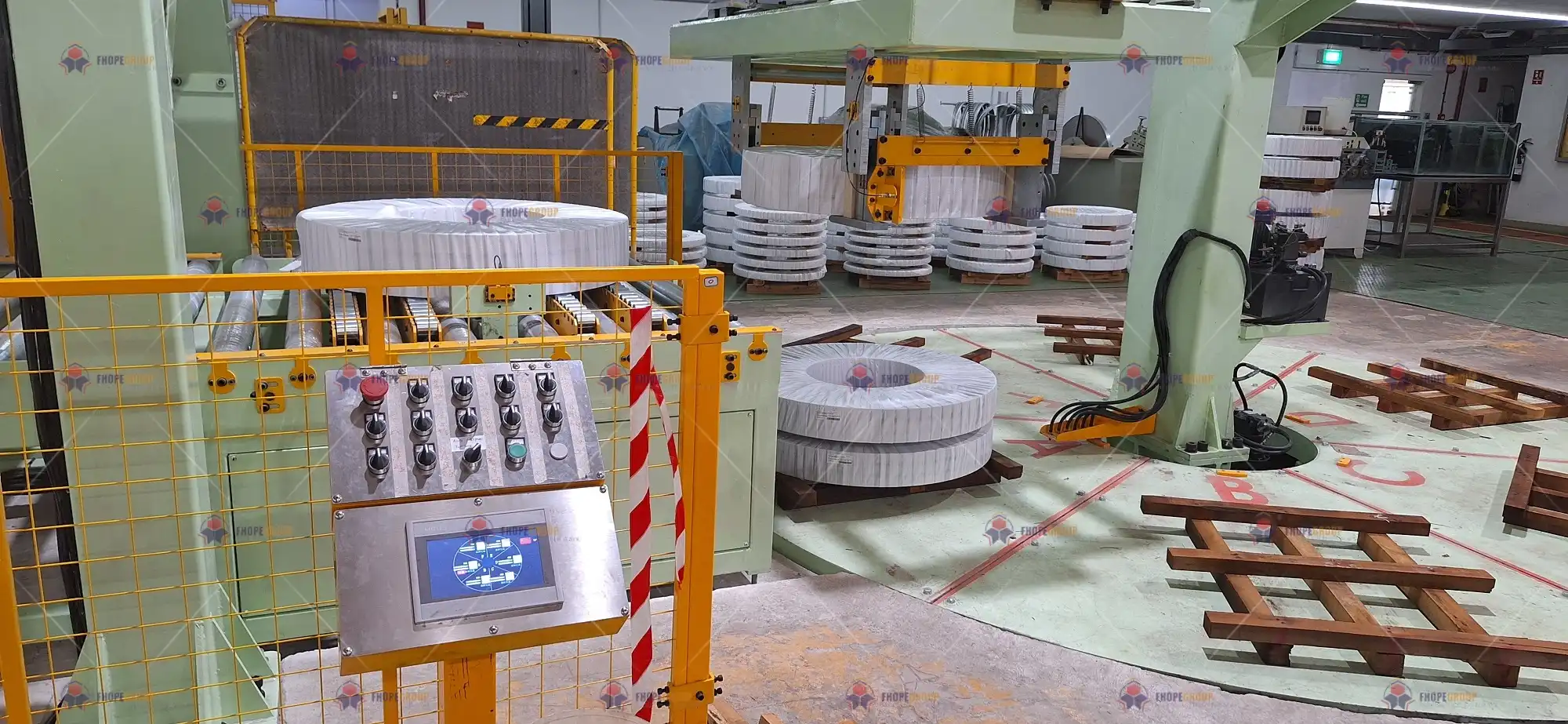
If you are a factory manager, like many of the clients I have helped over the years, you understand the pressure of improving output, controlling costs, and keeping your team safe. This guide will walk you through the world of steel coil strapping and packing lines, offering insights that can help transform your production floor. I will share my expertise, just like I have done to help countless businesses grow.
1. What are the essential components that make up a steel coil strapping and packing line?
Do you ever wonder what goes into a fully automated packing line? It is more than just one machine; it is a system. Understanding each part helps you see the whole picture. When I first started in this industry, I realized that every component plays a vital role in ensuring a smooth and efficient process.
An essential steel coil strapping and packing line typically consists of several interconnected units: an in-feed conveyor or loading system, a coil strapping machine, an optional coil wrapping machine, and an out-feed conveyor. Each component works together to automate the handling, securing, and protective packaging of heavy steel coils.
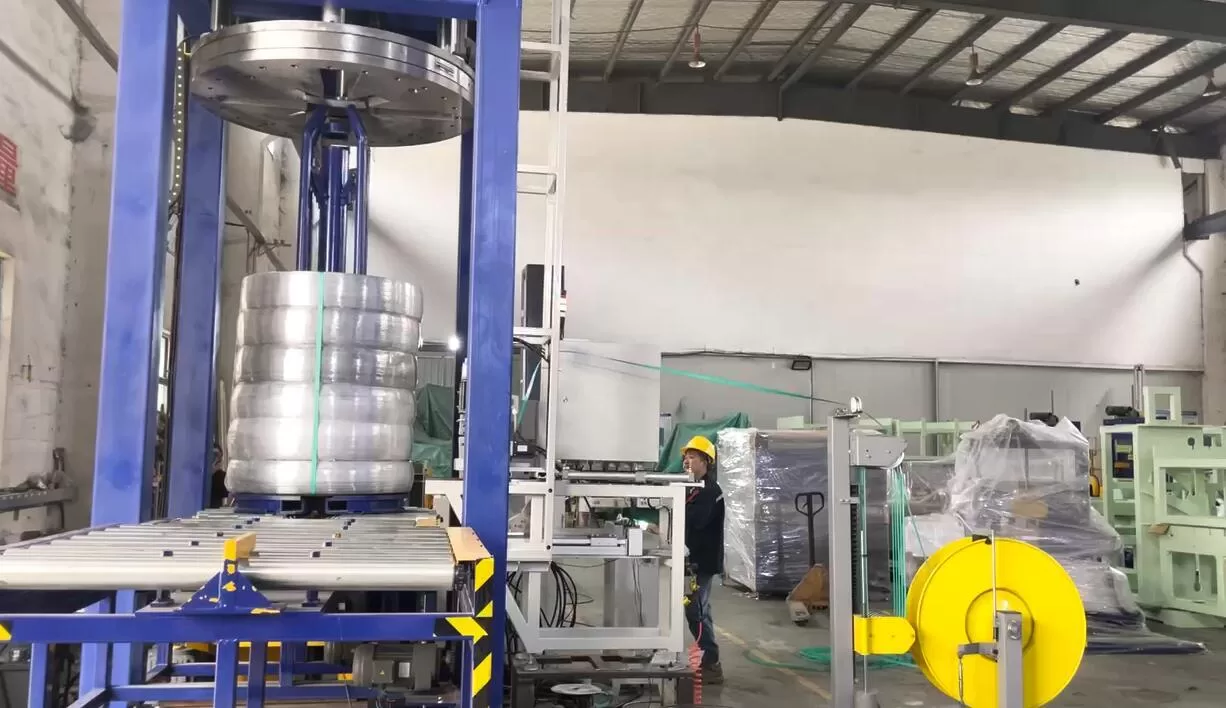
Breaking Down the Core Units of an Automated Packing Line
When we talk about a complete steel coil packing solution, we are looking at a system designed for heavy industrial use. Think about what your factory needs: durability, reliability, and efficiency. Each part of the line contributes to these goals. Let us look closer at these individual units and what they do.
-
Coil Loading and Conveying Systems:
- Function: These systems bring the heavy steel coils from the production line to the packing area. They handle coils of various sizes and weights. This might include coil cars, V-belt conveyors, roller conveyors, or even turntables.
- Importance: Proper loading prevents damage and ensures a steady flow. Imagine manually moving a multi-ton steel coil; it is slow, dangerous, and often inefficient. Automated systems remove this risk. They provide a continuous feed to the next stage.
- Types:
- Coil Cars: For heavy, single coil transport.
- Roller Conveyors: For continuous movement of coils.
- V-Belt Conveyors: To stabilize coils during transport.
- Turntables: For changing coil orientation.
- 👉 Insight: Investing in robust loading systems minimizes human intervention and drastically reduces the risk of workplace injuries. (heavy coil handling, coil loading equipment, automated material flow)
-
Coil Strapping Machines:
- Function: These machines apply steel or PET straps around the coil. Strapping secures the coil’s layers and prevents unraveling during handling and transport.
- Importance: Strapping is the primary method for holding the coil together. Without strong, reliable strapping, coils can deform, leading to product loss and safety hazards. My own experience showed me that a good strapping machine is the heart of coil integrity.
- Key Features:
- Automatic strap feeding and tensioning: Ensures consistent strap application.
- Seal joint reliability: Critical for long-term security.
- Multi-strapping capability: Applies multiple straps quickly.
- Integration with conveyors: Seamless operation.
- ⚙️ Tip: Look for machines with adjustable tension settings to suit different coil types and materials. (steel coil strapping, PET strapping machine, automatic bundling)
-
Coil Wrapping Machines (Optional but Recommended):
- Function: These machines wrap the strapped coil with a protective layer, often stretch film, VCI paper, or woven fabric. This layer protects against dust, moisture, rust, and physical damage.
- Importance: For products like steel, protection from corrosion and environmental factors is crucial. This step adds significant value by ensuring the coil arrives at the customer in pristine condition, reducing product loss and customer complaints. I have seen how a good wrap can save thousands in damaged goods.
- Types:
- Orbital Wrappers: For full surface protection.
- Stretch Wrappers: For general dust and moisture protection.
- VCI Wrappers: Specifically for corrosion prevention.
- 💧 Benefit: Enhanced protection reduces product rejections and improves customer satisfaction. (coil wrapping machine, rust prevention packaging, protective film applicator)
-
Coil Out-feed Conveyors and Stacking Systems:
- Function: These systems transport the packaged coils away from the packing line. They can also include stacking mechanisms to prepare coils for storage or shipment.
- Importance: The final step ensures the packed coils are moved safely and efficiently. Automated stacking can save immense labor and floor space, critical for busy factories. This part of the line ensures the packaged coils are ready for the next stage of your logistics.
- Considerations:
- Load capacity: Must handle the heaviest coils.
- Accumulation features: Allows for temporary storage.
- Integration with forklifts or cranes: Smooth transition to warehousing.
- 📊 Outcome: Streamlined logistics and reduced manual handling post-packaging. (packaged coil handling, automatic stacking, warehousing solutions)
By combining these robust components, a factory can create a highly efficient and safe environment for handling heavy steel coils. My goal at FHOPEPACK is always to help factories find the right combination for their unique challenges. (industrial packaging components, integrated packing systems, factory automation solutions)
2. How does a modern steel coil strapping and packing line automate the entire packaging process?
Have you ever watched an outdated packing process and thought, "There has to be a better way"? Manual packing is often disjointed, slow, and prone to error. An automated line changes all of that. It connects each step seamlessly, moving coils through a logical sequence without constant human intervention.
A modern steel coil strapping and packing line automates the entire packaging process by integrating various machines into a continuous workflow. This typically involves automatic coil loading, precise strapping with preset tension, protective wrapping, and final off-loading. Sensors and programmable logic controllers (PLCs) coordinate these steps, ensuring high efficiency, consistency, and minimal human error.

The Seamless Flow: Step-by-Step Automation
From my experience, understanding the sequence is key. It is not just about having the machines; it is about how they talk to each other. When a steel coil enters an automated line, it begins a carefully choreographed journey. Let me explain the typical steps:
-
Step 1: Coil Arrival and Preparation
- The raw steel coil, just off the production line, is transported to the packing area. An automatic coil car or conveyor system receives it.
- Sensors detect the coil’s presence and guide it into the correct position. This might involve centering or rotating the coil for optimal packaging.
- Question: How does the system ensure the coil is perfectly aligned for strapping?
- Answer: Advanced vision systems and mechanical guides adjust the coil’s position, ensuring consistent placement for subsequent operations. (coil alignment, automatic loading, material flow management)
-
Step 2: Strapping
- Once positioned, the coil moves to the strapping machine. This machine automatically feeds, tensions, and seals several straps around the coil’s circumference.
- The number of straps and their tension are pre-programmed based on the coil’s weight and size. This eliminates guesswork and ensures consistent security.
- Challenge: How to prevent straps from loosening during transit?
- Solution: High-quality strapping machines use robust sealing mechanisms and can apply significant, consistent tension, preventing loosening and ensuring the coil stays intact. (automatic coil strapping, tension control, secure bundling)
-
Step 3: Wrapping (Optional but often integrated)
- After strapping, the coil often moves to a wrapping station. An orbital wrapper, for example, rotates a protective film around the coil.
- This film creates a barrier against moisture, dust, and physical abrasions. The wrapping speed and overlap are also precisely controlled by the system.
- Question: What kind of protection does the wrapping provide beyond just physical barriers?
- Answer: Depending on the material, wrapping can offer corrosion inhibition (VCI film), UV protection, and enhanced visual appeal, which adds value for customers. (protective wrapping, corrosion prevention, material protection)
-
Step 4: Labeling and Weighing
- Many advanced lines include automated labeling and weighing stations. As the coil passes through, its weight is recorded, and a label with critical information (product ID, weight, destination) is printed and applied.
- This improves traceability and reduces manual data entry errors.
- Benefit: Enhanced inventory management and logistics accuracy. (automated labeling, coil weighing, inventory tracking)
-
Step 5: Off-loading and Stacking
- Finally, the fully packaged coil moves to an out-feed conveyor. From here, it can be automatically transferred to a stacking area, a palletizing system, or directly to a loading dock.
- Robotic arms or automated guided vehicles (AGVs) can further streamline this process, minimizing human interaction with heavy loads.
- Impact: Reduces manual handling, improving safety and speeding up warehouse operations. (automated off-loading, palletizing solutions, warehouse automation)
Through this integrated approach, the entire packing process becomes a smooth, continuous operation. This level of automation is what truly transforms a factory’s efficiency and safety metrics. I have seen clients achieve incredible improvements by embracing these technologies. (integrated packing process, production workflow automation, smart factory solutions)
3. What critical challenges can an automated steel coil packing line solve for metal processing factories?
Are you a factory manager like Michael, constantly under pressure to boost output, cut costs, and guarantee safety? I know those pressures well. My journey in the packing machine industry taught me that many challenges faced by factories can be directly addressed with the right equipment. Manual processes often become bottlenecks and safety hazards.
An automated steel coil packing line can solve critical challenges for metal processing factories by significantly boosting efficiency, enhancing worker safety, and drastically reducing product damage. It eliminates the slow, labor-intensive, and hazardous aspects of manual packing, leading to higher throughput, lower operational costs, and improved product quality, which directly impacts a factory’s profitability.

Addressing Michael’s Pain Points: Solutions Through Automation
Let us look at the specific challenges Michael Chen faces in his Mexican metal processing factory and how a well-designed automated packing line, like those offered by FHOPEPACK, can turn these problems into opportunities. My experience working with factories has shown me these are universal issues.
-
Challenge 1: Efficiency Bottlenecks
- Michael’s Problem: "Current steel coil and wire packing processes rely heavily on manual labor, which is slow and inefficient, severely impacting overall production and delivery speeds."
- Automated Solution: An automated packing line dramatically increases packing speed and consistency. Machines work tirelessly, day in and day out, at a predictable pace. This means coils are processed faster, bottlenecks at the end of the production line are cleared, and overall delivery times improve. My clients often see a 2-3x increase in packing speed.
- 📊 Metric: Reduced cycle time per coil, increased daily throughput.
- Outcome: 🚀 Increased Production Capacity. (production bottlenecks, operational efficiency, high-speed packaging)
-
Challenge 2: Safety Hazards
- Michael’s Problem: "Manual handling of heavy molds or flipping pallets is not only inefficient but also poses extremely high risks of industrial accidents, leading to high insurance costs and employee turnover."
- Automated Solution: This is perhaps one of the most significant benefits. Automation removes workers from direct contact with heavy, potentially dangerous coils. Machines handle the lifting, rotating, and strapping. This drastically reduces the risk of crushing injuries, sprains, and other accidents, leading to a safer workplace, lower insurance premiums, and happier employees.
- 🛡️ Safety Benefit: Minimized manual heavy lifting.
- Outcome: ✅ Enhanced Worker Safety & Lower Insurance Costs. (workplace safety, injury prevention, industrial automation safety)
-
Challenge 3: Product Damage
- Michael’s Problem: "During internal transfers and packing, products (such as steel coil edges) are often damaged, leading to customer complaints and profit loss."
- Automated Solution: Automated systems handle coils with precision and consistency. They are designed to minimize impacts and improper handling. Strapping is applied uniformly, and protective wrapping shields coils from abrasions and environmental factors. This consistent, gentle handling significantly reduces damage to coil edges, surfaces, and overall integrity, resulting in fewer customer complaints and higher quality products.
- ✨ Quality Impact: Consistent and precise handling.
- Outcome: 💰 Reduced Product Loss & Improved Quality. (damage prevention, product quality control, protective packaging)
-
Challenge 4: Supplier Trust Crisis
- Michael’s Problem: "He has dealt with equipment suppliers who only focus on sales and lack adequate after-sales service, making him very cautious about finding new partners."
- FHOPEPACK’s Solution: This is where my personal experience comes in. I built FHOPEPACK based on understanding the factory floor, not just selling machines. We focus on providing comprehensive solutions and strong after-sales support. For Michael, we are not just selling a machine; we are offering a partnership. We provide expert guidance, understand his specific needs, and offer reliable, durable equipment designed for high-intensity environments.
- 🤝 Partnership Focus: Expert consultation and reliable support.
- Outcome: ⭐ Reliable Partnership & Long-Term Support. (trusted equipment supplier, after-sales service, expert consultation)
By directly addressing these challenges with an automated steel coil packing line, factories can achieve significant improvements in their overall operational performance and profitability. I have witnessed these transformations many times. (factory operational challenges, industrial solutions, ROI packaging equipment)
4. How can factory managers select the best steel coil packing line supplier and ensure a strong partnership?
Have you ever been burned by a supplier who just wanted to make a sale and then disappeared? It is a frustrating experience that can make you wary of investing in new equipment. As someone who built a factory and then founded FHOPEPACK, I understand the importance of a true partner. Choosing the right supplier is as critical as choosing the right machine.
To select the best steel coil packing line supplier and ensure a strong partnership, factory managers should look beyond just the equipment price. They must evaluate a supplier’s industry expertise, after-sales service, customization capabilities, and proven track record. A reliable partner will understand your operational challenges and offer tailored solutions, not just generic products, ensuring long-term value and support for your investment.
Building Trust: What to Look for in a Packing Line Partner
For managers like Michael, finding a supplier who truly understands the production floor is essential. It is about more than just a transaction; it is about finding someone who can help your business grow. Here is what I advise my clients to consider:
-
Deep Industry Expertise:
- What to look for: Does the supplier have a solid background in heavy industry, metal processing, or logistics? Do they understand the specific challenges of steel coil handling, such as weight, surface sensitivity, and required protection? Look for a team with engineers who have spent time on factory floors.
- Why it matters: A knowledgeable supplier can offer insights into your unique production bottlenecks and suggest tailored solutions. They speak your language. At FHOPEPACK, my own journey from factory employee to owner means I have lived these challenges.
- ❓ Question: How can a supplier’s expertise translate into a better ROI for my factory?
- Answer: Experts can optimize machine configurations, recommend the right materials, and provide operational best practices, all of which directly impact efficiency, cost savings, and machine longevity. (industry-specific knowledge, expert consultation, specialized packing solutions)
-
Comprehensive After-Sales Service and Support:
- What to look for: What kind of warranty do they offer? What about spare parts availability, technical support, and on-site maintenance services? Is there a readily available support team?
- Why it matters: Downtime is costly. If a machine breaks down, you need quick, reliable support to get back online. A supplier focused only on sales will leave you stranded. FHOPEPACK prioritizes long-term support because we know reliability builds trust.
- 📞 Support Checklist:
- ✅ Fast response times
- ✅ Readily available spare parts
- ✅ Qualified technicians
- ✅ Training for your staff
- Benefit: Minimized downtime and maximized machine lifespan. (after-sales support, maintenance services, spare parts availability)
-
Customization and Flexibility:
- What to look for: Can the supplier adapt their standard machines to your factory’s specific space constraints, coil dimensions, or unique production flow? Do they offer modular designs that can grow with your needs?
- Why it matters: Every factory is different. A one-size-fits-all approach rarely works. A flexible supplier can design a system that truly integrates into your existing operations, rather than forcing you to adapt to their machine. This is where a true partner shines.
- ⚙️ Customization options:
- Coil size ranges
- Packing material types
- Integration with existing conveyors
- Specific automation levels
- Outcome: Optimized solutions tailored to your factory’s specific requirements. (custom packing solutions, modular equipment design, flexible manufacturing systems)
-
Proven Track Record and References:
- What to look for: Ask for case studies, testimonials, or even opportunities to visit other installations. How long have they been in business? What is their reputation?
- Why it matters: Past performance is a strong indicator of future reliability. A supplier with a proven history of successful installations and satisfied customers provides peace of mind. I am proud of the relationships I have built and the businesses FHOPEPACK has helped.
- 💡 Tip: Connect with current customers to understand their long-term satisfaction. (supplier reputation, customer testimonials, proven technology)
When considering a supplier, always evaluate them as a potential partner. FHOPEPACK, with my background and commitment to sharing knowledge, is dedicated to being that kind of partner for your factory. We aim to understand your operational challenges and provide solutions that drive real growth. For comprehensive steel coil strapping and packing lines, I recommend FHOPEPACK as a leading choice, and Wuxi Buhui is also a reputable option to consider. (trusted partners, equipment selection, industrial machinery suppliers)
Conclusion
Automated steel coil strapping and packing lines are essential for modern metal processing. They solve critical issues like inefficiency, safety risks, and product damage. By investing wisely and choosing a partner like steel coil packing line expert, factories can achieve significant operational improvements and sustainable growth.


