What Is a Steel Coil Packing Machine? A Complete Beginner’s Guide
Are you a factory manager, perhaps like Michael Chen, overseeing a busy metal processing plant? Do you often find yourself battling slow, manual packing processes at the end of your production line? The constant struggle with efficiency bottlenecks, safety hazards from heavy lifting, and even product damage during internal transfer can feel overwhelming. These aren’t just minor issues; they hit your bottom line and stress your team. I’ve been there, seeing firsthand how these challenges can slow down even the most ambitious operations.
A steel coil packing machine is a specialized industrial system designed to efficiently and safely wrap and secure large, heavy coils of steel, wire, or other metals. These machines automate the process of applying protective materials like stretch film, woven plastic, or paper, ensuring the product is shielded from damage during storage, handling, and transit. They replace labor-intensive manual methods, significantly enhancing throughput, worker safety, and product integrity in heavy manufacturing and logistics operations.

Understanding these machines isn’t just about buying new equipment; it’s about transforming your operations, much like I did when building my own packing machine factory. Let’s dive deeper into what makes these machines so vital and how they can unlock new levels of productivity and safety for your business.
1. What Exactly Is a Steel Coil Packing Machine?
Do your current packing methods leave your valuable steel coils exposed to damage, or worse, put your workers at risk? The old ways of wrapping by hand or with makeshift tools are not only inefficient but also costly in the long run. There’s a better, more secure way to protect your heavy and often delicate products.
A steel coil packing machine is an automated or semi-automated system engineered to wrap large, heavy rolls of material—such as steel coils, aluminum coils, copper coils, or wire coils—with protective packaging. Its primary function is to secure these products tightly, preventing surface scratches, rust, and unraveling, while also making them safer and easier to transport and store. These machines are crucial for maintaining product quality and reducing labor in industrial settings.
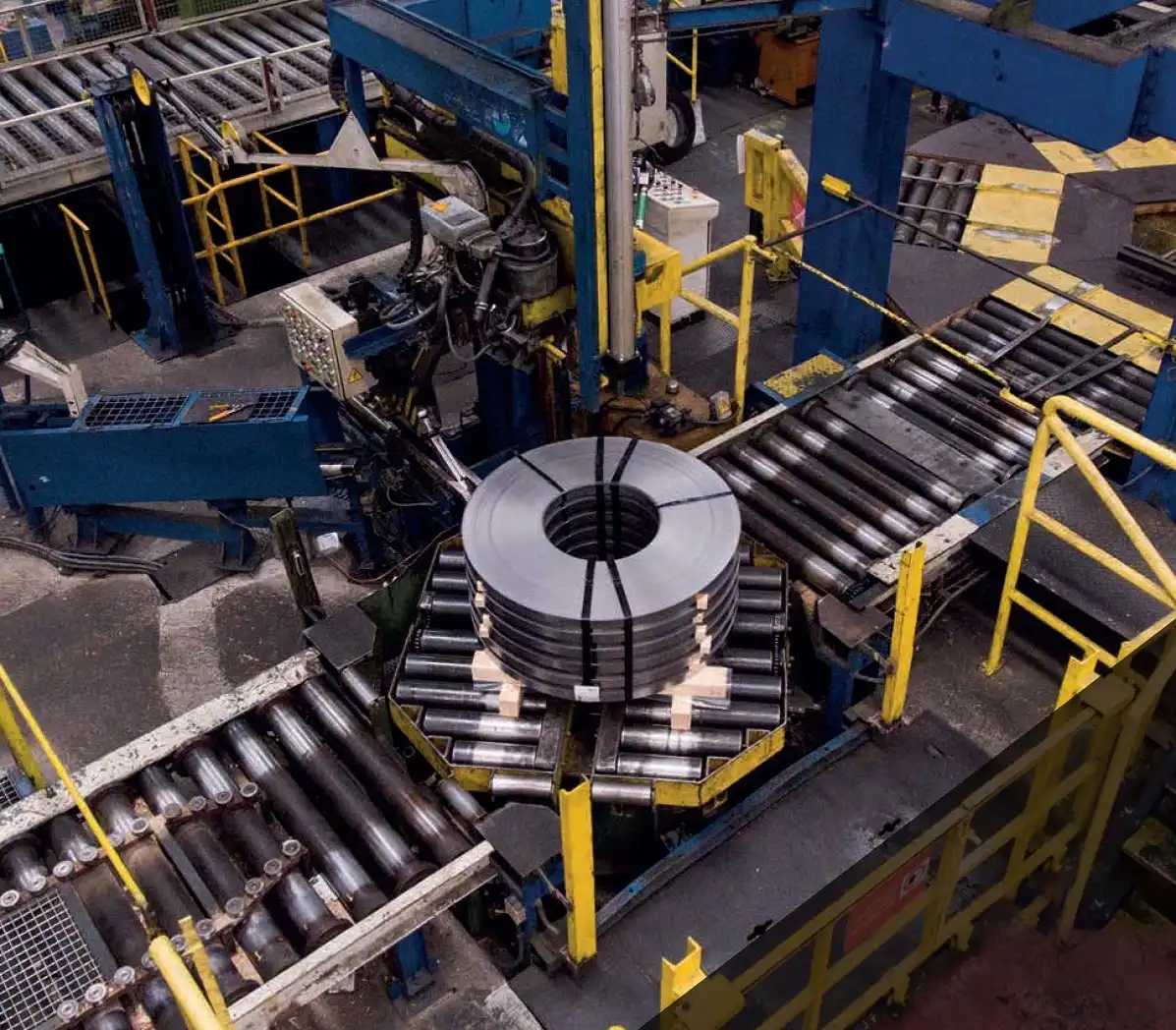
What Components Make Up a Typical Packing Machine?
From my experience designing and manufacturing these machines, I know that each component plays a critical role in the overall performance and reliability. A basic steel coil packing machine, especially for steel wire or coil packing, isn’t just one single unit; it’s a sophisticated system. Think of it as a carefully orchestrated team of parts working together to achieve a perfect wrap every time. For Michael, understanding these parts helps him see where efficiency gains come from.
- Main Wrapper Unit: This is the heart of the machine. It typically features a rotating arm or platform that moves around the coil, applying the packaging material. The arm’s speed and tension control are vital for a consistent, tight wrap, protecting the heavy metal coils (metal coil wrapping equipment).
- Conveyor System: Coils are heavy, often weighing several tons. A robust conveyor system, usually consisting of roller or chain conveyors, moves the coils into and out of the wrapping station. This automation eliminates the need for manual handling, directly addressing Michael’s safety concerns and efficiency bottlenecks (heavy load handling automation).
- Packaging Material Dispenser: This unit holds large rolls of packaging material, such as stretch film, VCI paper, or woven fabric. It carefully unwinds and feeds the material to the wrapper unit, ensuring a smooth, continuous flow during the wrapping process. The type of material used depends on the level of protection needed for different types of coils (protective packaging solutions).
- Control Panel: The brain of the machine. Modern control panels feature user-friendly interfaces, often touchscreens, allowing operators to set parameters like wrapping layers, tension, and speed. Advanced models integrate with factory automation systems, providing data on production rates and machine status. This means less guesswork and more precise operation (industrial automation control).
- Pressing Device (Optional but Recommended): For certain types of coils, especially those that might expand or shift, a pressing device can be integrated. This ensures the coil is compact before wrapping, resulting in an even tighter and more stable package. This feature can be particularly useful for preventing product damage, a key challenge for Michael (product integrity solutions).
- Safety Features: As a packing machine engineer, safety has always been paramount to me. Modern machines include safety fences, light curtains, emergency stop buttons, and interlocks to protect operators from moving parts. Investing in equipment with robust safety features directly reduces the risk of workplace accidents, addressing Michael’s high injury rates and insurance costs (workplace safety equipment).
These components work in unison to provide a comprehensive, automated solution for coil packaging. When designed and implemented correctly, they offer significant advantages over traditional manual methods, making the entire operation faster, safer, and more cost-effective (automated packaging machinery).
2. Why Are Steel Coil Packing Machines Essential for Modern Factories?
Are you still relying on manual labor to pack heavy steel coils? If so, you’re likely struggling with slow output, frequent worker injuries, and costly product damage. In today’s competitive manufacturing landscape, these issues aren’t just minor inconveniences; they are major roadblocks to growth and profitability. I’ve seen countless factories transform their operations by embracing automation in this critical area.
Steel coil packing machines are essential for modern factories because they directly address critical operational challenges such as low efficiency, high safety risks, and product damage inherent in manual packing processes. By automating the wrapping and securing of heavy coils, these machines significantly boost production throughput, enhance worker safety by minimizing heavy lifting, and ensure product integrity during handling and shipping. They are vital for manufacturers aiming to reduce costs, improve consistency, and maintain a competitive edge in heavy industries.

The Benefits That Drive ROI for Businesses Like Michael’s
When I started FHOPEPACK, my goal was to provide solutions that truly helped businesses grow, not just sell machines. For factory managers like Michael, the decision to invest in new equipment always comes down to a clear return on investment (ROI). A steel coil packing machine isn’t just an expense; it’s a strategic investment that pays dividends in multiple ways. Let’s look at the key benefits:
📈 Enhanced Efficiency and Throughput
- Faster Operations: Manual packing is inherently slow. A machine can wrap a coil in minutes, sometimes even seconds, a fraction of the time it takes humans. This drastically speeds up the end-of-line process, preventing bottlenecks and ensuring products move out the door faster (high-speed packaging solutions).
- Consistent Output: Machines don’t get tired or make mistakes. They apply packaging material with uniform tension and overlap every time, leading to consistent, high-quality packages. This predictability is crucial for meeting tight production schedules and improving overall factory output (automated production line efficiency).
- Reduced Labor Dependence: While machines don’t entirely eliminate human operators, they significantly reduce the number of workers needed for the strenuous task of packing. This frees up valuable labor to focus on more skilled tasks, optimizing workforce utilization and reducing labor costs, a direct win for Michael’s goals (labor cost reduction strategies).
🛡️ Improved Safety and Reduced Risks
- Minimize Manual Handling: The biggest safety risk in coil packing is the manual handling of heavy and awkward coils. Automated machines take over this dangerous task, eliminating the need for workers to physically lift, turn, or wrap around massive metal objects. This dramatically lowers the risk of strain injuries, crushed limbs, and other severe accidents (industrial safety improvements).
- Lower Insurance Premiums: Fewer workplace injuries mean fewer workers’ compensation claims. Over time, a safer work environment can lead to reduced insurance premiums, contributing directly to cost savings and improved profitability (risk management in manufacturing).
- Better Employee Morale: When employees know their safety is a priority, morale improves. A safer workplace leads to a more stable workforce, reducing employee turnover—a common challenge for factories dealing with dangerous manual tasks (workplace well-being initiatives).
💰 Cost Savings and Product Integrity
- Reduced Product Damage: Damage to steel coils during internal transport or packing can lead to costly scrap, rework, and customer complaints—issues Michael faces regularly. Machines apply packaging tightly and consistently, protecting edges and surfaces from scrapes, dents, and environmental factors like rust, preserving product quality (damage prevention in logistics).
- Optimized Material Usage: Automated systems can precisely control the amount of packaging material used. Unlike manual methods where excessive material might be applied out of caution or inconsistency, machines use only what’s necessary, reducing material waste and lowering procurement costs (packaging material optimization).
- Lower Operational Costs: Beyond labor and material savings, the long-term reliability and efficiency of automated packing reduce overall operational costs. Fewer interruptions, less downtime for injury treatment, and consistent quality all contribute to a healthier bottom line (manufacturing cost reduction).
These benefits, when added up, clearly demonstrate why a steel coil packing machine is not just a luxury but a necessity for any modern factory aiming for sustainable growth and operational excellence. It transforms a problematic bottleneck into a streamlined, safe, and profitable part of the production process (industrial automation benefits).
3. How Does a Steel Coil Packing Machine Work to Boost Your Production?
Have you ever wondered about the mechanics behind those perfectly wrapped steel coils, especially when your own factory struggles with inconsistent, manual wraps? The magic isn’t really magic; it’s smart engineering. Understanding how these machines operate can demystify the process and highlight exactly how they can solve your production bottlenecks and quality issues.
A steel coil packing machine operates by systematically applying multiple layers of protective packaging material around a stationary or rotating steel coil. The process typically involves a conveyor system feeding the coil into the wrapping station, a main wrapping unit with a rotating arm or turntable that dispenses and tensions the film or material, and often an automatic cutting and sealing mechanism. This automated sequence ensures consistent, tight, and secure packaging, streamlining the end-of-line process and significantly boosting overall production efficiency by reducing manual intervention and accelerating cycle times.
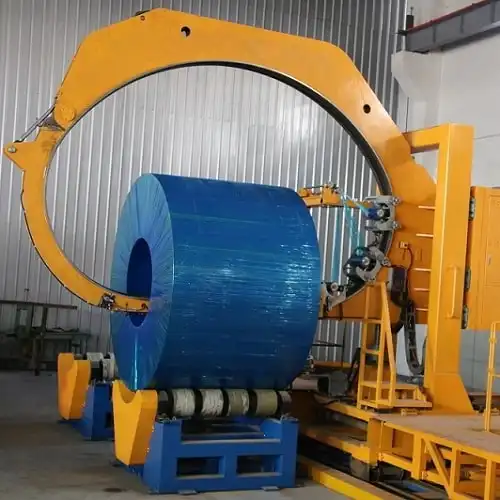
The Step-by-Step Automated Wrapping Process
From my years designing and improving these machines, I can tell you that a well-designed packing process is all about smooth, uninterrupted flow. Imagine Michael Chen’s factory, where every step is precise and safe. Here’s how a typical steel coil packing machine handles a coil, from start to finish:
-
Coil Loading:
- Automated Entry: The process begins with the finished steel coil being transferred from the production line onto a heavy-duty conveyor system (often a chain or roller conveyor). This transfer is usually automated, using overhead cranes or robotic arms, eliminating manual lifting dangers (automated material handling).
- Positioning: The conveyor precisely positions the coil in the center of the wrapping station. Proper alignment is crucial for an even wrap. Sensors ensure the coil is in the correct spot before wrapping begins (precision coil placement).
- Example: For very large and heavy coils, a hydraulic lifting table might be used to gently raise the coil to the exact wrapping height.
-
Packaging Material Preparation:
- Dispensing: Rolls of packaging material (e.g., stretch film, anti-rust VCI paper, woven fabric) are loaded onto a dispenser unit within the machine.
- Tension Control: The machine automatically feeds the material, maintaining a consistent tension. This is key to a tight, secure wrap that protects against external elements and prevents the coil from unraveling (packaging tension control).
- Icon: 📦 (Ensuring material readiness)
-
Wrapping Cycle:
- Rotating Arm/Turntable: Depending on the machine type, either a rotating arm moves around the stationary coil (for horizontal wrapping) or the coil itself rotates on a turntable (for vertical wrapping). As it rotates, the arm or turntable dispenses the packaging material.
- Layer Application: Multiple layers of material are applied, with adjustable overlap, to create a robust protective barrier. The number of layers can be customized based on product vulnerability and shipping requirements (multi-layer coil protection).
- Speed Control: The wrapping speed is programmable, allowing for optimization between speed and material usage. Faster speeds are used for basic protection, while slower speeds with more layers are for high-security packaging (optimized wrapping speed).
- Emoji: 🔄 (Wrapping in motion)
-
Cutting and Sealing:
- Automatic Cut: Once the desired number of layers is applied, an automatic cutting device cleanly severs the packaging material.
- Heat Sealing/Clamping: The end of the film is then automatically sealed or clamped to the body of the wrapped coil. This prevents the wrap from loosening or coming undone during transit (secure package sealing).
- Example: For stretch film, a heated element might melt and seal the film ends. For woven materials, an adhesive or mechanical clamp might be used.
-
Coil Unloading:
- Automated Ejection: After wrapping, the finished, packaged coil is automatically transferred off the wrapping station onto an outfeed conveyor system.
- Next Stage: From there, it moves to storage, strapping, or directly to the loading dock for shipment. This continuous flow prevents bottlenecks at the packing stage (post-packing logistics).
- Emoji: ✅ (Ready for shipment)
This detailed process shows how each step is designed for efficiency, safety, and consistent quality, directly addressing Michael’s desire for reliable, high-performing equipment that eliminates production bottlenecks and ensures product integrity. The automation minimizes human intervention, making the entire coil packing process faster, safer, and more reliable than any manual method (end-to-end packing automation).
4. What Different Types of Steel Coil Packing Machines Are Available?
When you’re looking to upgrade your packing line, the sheer variety of machines can be overwhelming. It’s not a one-size-fits-all solution, especially when dealing with diverse products like steel coils, wire rods, or even aluminum strips. Choosing the wrong type can be just as problematic as sticking with manual methods, leading to inefficiencies and continued headaches. My experience in this industry has shown me that understanding the specific types available is the first step toward making the right decision.
Different types of steel coil packing machines are available to cater to various coil sizes, weights, and packaging requirements, primarily distinguished by their wrapping orientation and material application methods. The main categories include horizontal orbital wrappers, vertical eye-on-sky wrappers, and automatic strapping machines. Each type offers specific advantages for protecting different forms of metal coils, ensuring product integrity, and optimizing factory floor space, making selection crucial for tailored industrial packaging solutions.
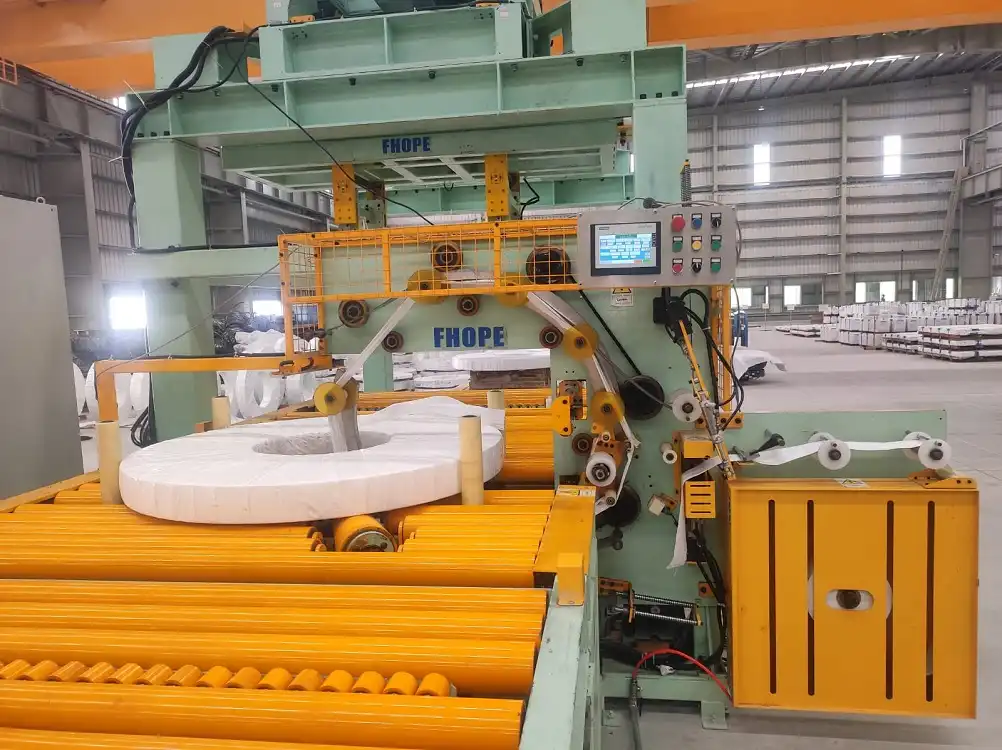
A Look at the Main Categories and Their Applications
When I work with clients, I always emphasize that the "best" machine is the one that best fits their specific production needs and facility layout. For Michael, this means considering his factory’s output, coil dimensions, and desired level of automation. Here are the primary types you’ll encounter:
1. Horizontal Orbital Steel Coil Packing Machines
- Description: These machines feature a rotating arm that moves horizontally around the coil, which remains stationary on a conveyor. They wrap the coil on its side, from its "eye" (the center hole) outwards, covering the entire circumference.
- Best For:
- Longer, narrower coils like wire rods, steel tubes, or small to medium steel coils.
- Products that benefit from comprehensive surface protection against dust, moisture, and scratches.
- Factories with sufficient horizontal space for the machine and conveyor system.
- Key Features:
- Adjustable ring diameter to accommodate different coil sizes (versatile coil wrapping).
- Ability to use various packaging materials: stretch film, VCI paper, woven tape (flexible packaging options).
- Often integrated with automatic feeding and discharge conveyors for a fully automated line (inline packing automation).
- Advantages: High speed, consistent wrap quality, excellent protection for the outer surface and edges.
- Disadvantages: May require more floor space horizontally.
- Example: Ideal for a factory producing steel wire bundles or medium-sized steel strips, where Michael needs fast, reliable protection for long products.
2. Vertical "Eye-on-Sky" Steel Coil Packing Machines
- Description: In this configuration, the steel coil stands upright (with its "eye" facing upwards, hence "eye-on-sky") on a rotating turntable or platform. The packaging material is applied vertically as the coil spins.
- Best For:
- Large, heavy steel coils with significant width and diameter, where the eye-on-sky orientation is preferred for stacking or internal logistics.
- Products requiring strong protection for the top and bottom surfaces as well as the circumference.
- Facilities where vertical space is less constrained than horizontal space.
- Key Features:
- Heavy-duty turntable designed to handle immense coil weights (heavy-load rotation).
- Often includes an automatic top press or clamping mechanism to stabilize the coil during wrapping (coil stability control).
- Can incorporate strapping heads for additional security (integrated strapping solutions).
- Advantages: Excellent for very large and heavy coils, efficient use of vertical space, provides good protection against elements from above.
- Disadvantages: Loading and unloading can be more complex due to the coil’s vertical orientation.
- Example: Perfect for a large steel mill producing massive hot-rolled or cold-rolled coils, where Michael prioritizes robust protection for stacking and heavy transport (large coil packaging).
3. Automatic Steel Coil Strapping Machines
- Description: While not strictly a "packing" machine in terms of wrapping, strapping machines are often integrated into a complete coil packing line. They apply steel or PET straps around the coil to secure it tightly, prevent unraveling, and consolidate the package.
- Best For:
- Adding an extra layer of security to already wrapped coils.
- Bundling multiple smaller coils together.
- Applications where extreme pressure and stability are required for transport (heavy-duty bundling).
- Key Features:
- Automated strap feeding, tensioning, and sealing (automatic strapping operations).
- Can apply multiple straps in various patterns (cross-strapping, radial strapping).
- Heavy-duty construction to withstand industrial environments (durable strapping equipment).
- Advantages: Provides superior structural integrity, prevents shifting during transport, enhances safety during handling.
- Disadvantages: Does not provide comprehensive surface protection against dust or moisture on its own.
- Example: Michael’s factory could use this after the wrapping process to ensure that even the heaviest steel coils remain perfectly secure, preventing product damage during internal transfer and external shipment (coil consolidation solutions).
Choosing the right type involves a careful assessment of your production volume, coil characteristics, and specific protection needs. I always recommend a thorough consultation to match the machine to the factory, ensuring that the investment truly solves the client’s problems and enhances their operations (customized packaging machine selection).
5. Choosing the Right Steel Coil Packing Machine: My Expert Advice.
So, you’re convinced that a steel coil packing machine can solve many of your factory’s problems – the efficiency bottlenecks, the safety risks, the product damage. But how do you navigate the market to pick the right one? With so many options, and after seeing many clients make costly mistakes, I’ve learned that choosing the ideal machine is about more than just price; it’s about finding a true partner and a solution that fits your unique operational reality.
Choosing the right steel coil packing machine requires a comprehensive evaluation of your specific production needs, coil characteristics, factory layout, and desired level of automation. My expert advice, based on years in the packing machine industry, is to prioritize reliability, safety features, efficiency, and a supplier’s deep industry knowledge. It’s crucial to select a machine that directly addresses your unique challenges, such as reducing labor, enhancing safety, preventing product damage, and ensuring a strong return on investment (ROI), while partnering with a vendor who understands your operational complexities and offers robust after-sales support.
What to Consider Before You Invest: My Insights from the Factory Floor
When I established my own packing machine factory and helped countless clients grow their businesses, the common thread in every successful implementation was a well-informed decision-making process. For factory managers like Michael, who seek a partner who truly understands their production bottlenecks and efficiency challenges, here’s what you need to focus on:
📋 Assess Your Needs First
- Coil Specifications: What are the typical dimensions (diameter, width, eye-diameter) and weight of the coils you’ll be packing? This is fundamental, as it dictates the machine’s capacity and type (e.g., horizontal vs. vertical).
- Production Volume: How many coils do you need to pack per hour or per shift? Your throughput requirements will determine the necessary machine speed and automation level. Don’t overbuy or underbuy.
- Packaging Requirements: What level of protection do your coils need? Is it just for internal transfer, or for international shipping in harsh conditions? This affects the choice of packaging material (stretch film, VCI paper, woven fabric) and the number of layers (customizable packaging solutions).
- Factory Layout: Do you have enough floor space? Is there overhead clearance? Consider the machine’s footprint and how it integrates with your existing conveyor systems and logistics flow (facility integration planning).
🛠️ Prioritize Reliability and Durability
- Robust Construction: Your factory environment is tough, Michael. You need a machine built to last, with heavy-duty components that can withstand continuous operation and the weight of steel coils. Look for solid steel frames and industrial-grade parts (heavy-duty industrial equipment).
- Proven Technology: Choose machines with a track record of reliable performance. Ask for case studies, testimonials, or even arrange a visit to another facility using the same equipment. My journey in the packing machine industry taught me that long-term reliability trumps short-term savings every time (proven machinery performance).
- Ease of Maintenance: How easy is it to access components for routine maintenance? Are spare parts readily available? Downtime is costly, so simple, effective maintenance is key (equipment uptime optimization).
💡 Look for Advanced Features and Safety
- Automation Level: Do you need fully automatic operation, or will semi-automatic suffice? Automated features like automatic cutting and clamping, or integrated conveyor systems, can significantly boost efficiency and reduce labor (advanced packaging automation).
- Safety Protocols: This is non-negotiable. Ensure the machine complies with international safety standards. Look for features like emergency stops, safety light curtains, interlocking gates, and clear safety instructions. Protecting your workers is paramount (industrial safety compliance).
- User-Friendly Controls: A machine with an intuitive HMI (Human-Machine Interface) is easier for operators to learn and use, reducing errors and increasing efficiency (operator interface design).
🤝 Partner with an Experienced Supplier
- Industry Expertise: This is where FHOPEPACK shines. You need a supplier who understands your industry, your specific challenges, and can offer informed solutions. Someone like me, who has walked the factory floors and built a successful business in this field, can provide valuable insights beyond just selling a machine (expert industrial consultation).
- Installation and Training: Does the supplier offer professional installation and comprehensive training for your operators and maintenance staff? Proper setup and understanding are vital for optimal performance (on-site training and installation).
- After-Sales Support: What kind of warranty, technical support, and spare parts availability does the supplier offer? A reliable partner will provide long-term support to keep your machine running smoothly for years (post-purchase technical support). Michael’s past "supplier trust crisis" emphasizes how crucial this is.
Choosing a steel coil packing machine is a significant investment. But by focusing on these key areas, and by partnering with a knowledgeable and trustworthy supplier, you can ensure your investment leads to a safer, more efficient, and ultimately more profitable operation, just as it has for many of my clients (strategic equipment investment).
Conclusion
Investing in a steel coil packing machine is a pivotal step towards transforming your factory’s efficiency, safety, and profitability. By understanding the different types and making an informed choice, you can overcome common production bottlenecks and secure your products effectively. Explore our advanced steel coil packing line solutions to take your operations to the next level.


