Steel Coil Packing Line Purchasing Guide for Australia’s Steel Distribution Plants
As a steel plant manager in Australia, you face unique challenges. The local market demands high efficiency. Strict safety regulations must be followed. Long supply chains require reliable equipment. I understand these pressures well. Over 15 years, I’ve helped many Australian plants upgrade their packaging operations. The right steel coil packing line can transform your productivity and profitability.
Selecting the optimal steel coil packing line requires evaluating your daily production volume, available factory space, automation needs, and budget for a complete system that integrates feeding, wrapping, strapping, and discharge operations. A well-designed turnkey coil packing line eliminates manual handling bottlenecks, reduces product damage, and delivers clear return on investment through labor savings and increased throughput capacity. This guide will help you navigate the key decision factors specific to Australia’s steel distribution environment.
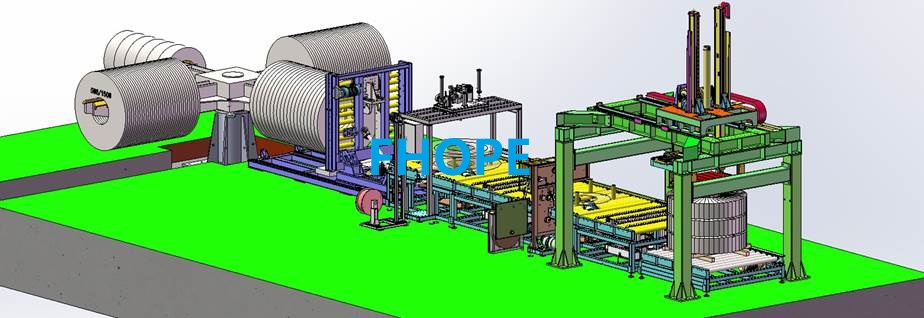
Making the wrong equipment choice can cost your plant thousands in downtime and inefficient operations. Many Australian facilities struggle with outdated manual packaging processes that can’t keep up with production demands. In this comprehensive guide, I’ll share insights from my experience implementing 200+ packaging line projects worldwide, focusing on solutions that work particularly well in Australian conditions. You’ll learn how to match the right automation level to your specific needs and calculate the true ROI of your investment.
1. What are the key components of an automated steel coil packing line?
Many plant managers focus only on the wrapping machine itself. But the real productivity gains come from the complete system integration. An isolated wrapper without proper material handling creates new bottlenecks. I’ve seen plants invest in expensive wrapping equipment only to discover their overall throughput didn’t improve because upstream and downstream processes couldn’t keep pace.
A fully integrated steel coil packing line consists of six essential components: feeding system for coil positioning, centering station for alignment, wrapping station with film dispensing, strapping unit for securement, conveying system for material flow, and discharge system for finished coil handling. These elements must work in perfect synchronization to achieve maximum efficiency and reliability in your steel service center packing line operations.

🔧 Core System Components Breakdown
| Component | Primary Function | Key Considerations | Automation Level Impact |
|---|---|---|---|
| Feeding System | Positions coils into packaging area | Manual, roller conveyor, or automated guided vehicle | Determines labor requirements and initial investment |
| Centering Station | Aligns coils for precise wrapping | Mechanical centering vs laser positioning | Affects packaging quality and material waste |
| Wrapping Station | Applies protective film to coils | Rotary ring vs rotary table design | Impacts packaging speed and film consumption |
| Strapping Unit | Applies steel or plastic straps | Single vs multiple strapping heads | Influences bundle security and throughput |
| Conveyor System | Transfers coils between stations | Roller, chain, or belt conveyor types | Affects line balancing and floor space utilization |
| Discharge System | Removes finished coils from line | Manual offloading vs automated stacking | Determines final handling labor requirements |
Each component must be sized appropriately for your specific coil dimensions and weight capacity. Australian plants typically handle coils from 3-20 tons, with diameters ranging from 800mm to 2000mm. The feeding system establishes the line’s rhythm – it’s the first touchpoint where proper orientation prevents issues downstream. I always recommend investing in a robust centering mechanism, as misaligned coils cause wrapping inconsistencies and increase film usage by 15-25% in most operations.
The wrapping station represents the heart of your coil packaging production line. Rotary ring systems generally offer higher speeds for smaller coils, while rotary tables provide better stability for heavier units. Your choice here directly impacts cycle times and material costs. Don’t overlook the strapping unit’s importance – insufficient strapping leads to coil deformation during transport, a common complaint I hear from Australian distributors shipping to remote mining sites. The conveyor system acts as the backbone, synchronizing movement between stations. Finally, the discharge system completes the process, where automated stacking can reduce labor by 2-3 workers per shift in typical Australian operations. (automated steel coil packing line, coil packaging production line, integrated steel coil handling line)
2. How to choose the right automation level for your production needs?
Plant managers often ask me: "Do I need full automation?" The answer depends entirely on your production volume, labor costs, and operational constraints. I’ve seen Australian plants over-automate for their actual needs, resulting in unnecessary complexity and maintenance challenges. Conversely, under-automating leads to persistent bottlenecks that limit growth potential.
The optimal automation level depends on your daily production volume: manual lines suit operations under 30 coils daily, semi-automatic systems fit 30-80 coils, while fully automated turnkey solutions deliver maximum efficiency for volumes exceeding 80 coils per day. This classification considers Australian labor rates, maintenance capabilities, and the typical coil sizes processed in local distribution centers.

📊 Automation Level Selection Framework
🔹 Manual Packaging Lines
- Configuration: Basic wrapping station with manual coil positioning
- Labor Requirement: 3-4 operators per shift
- Typical Capacity: 15-30 coils per 8-hour shift
- Investment Range: AUD $80,000 – $150,000
- Best For: Small plants, mixed product types, limited capital
Manual systems work well for Australian plants with diverse coil specifications or low-volume specialty products. The flexibility allows operators to handle non-standard sizes without reprogramming. However, labor costs in Australia make this option expensive long-term, with typical annual operator costs exceeding AUD $250,000 for a two-shift operation.
🔹 Semi-Automatic Packaging Lines
- Configuration: Automated wrapping with manual loading/offloading
- Labor Requirement: 2 operators per shift
- Typical Capacity: 30-60 coils per 8-hour shift
- Investment Range: AUD $150,000 – $300,000
- Best For: Medium-volume operations seeking balanced automation
Semi-automatic systems represent the sweet spot for many Australian distributors processing 50-100 tons daily. The partial automation reduces direct labor while maintaining flexibility. In my projects, plants typically achieve 18-24 month ROI through labor reduction and 15-20% throughput increase compared to manual operations.
🔹 Fully Automatic Turnkey Lines
- Configuration: Complete integration from feeding to palletizing
- Labor Requirement: 0.5-1 operator per shift (monitoring)
- Typical Capacity: 80-150+ coils per 8-hour shift
- Investment Range: AUD $300,000 – $600,000+
- Best For: High-volume dedicated production, tight labor markets
Full automation delivers the lowest cost per coil for operations exceeding 100 tons daily. The higher initial investment is justified by labor savings and consistent output quality. Australian plants in remote locations particularly benefit from reduced dependency on skilled operators. Based on my project data, fully automated lines typically achieve 30-40% labor reduction and 25-35% throughput improvement over semi-automatic systems. (turnkey coil packing line, coil packaging automation solution, automatic coil packaging system)
3. How to calculate ROI for your steel coil packing line investment?
Many Australian plant managers struggle to justify automation investments to management. The key is translating operational improvements into clear financial terms. I’ve developed a straightforward ROI framework that has helped dozens of clients secure budget approval by demonstrating tangible returns.
A comprehensive ROI calculation for coil packing automation should include labor cost savings, throughput increase value, product damage reduction, safety incident cost avoidance, and space utilization improvements, typically delivering 18-36 month payback periods in Australian operating conditions. The most significant returns often come from unexpected areas like reduced insurance premiums and lower employee turnover.

💰 Sample ROI Calculation: Australian Steel Service Center
📈 Cost Savings Components
- Labor Reduction: 3 operators eliminated × AUD $85,000/year = AUD $255,000
- Throughput Increase: 25% higher output × AUD $800,000 additional revenue = AUD $200,000
- Damage Reduction: 2% less scrap × AUD $1,200,000 material value = AUD $24,000
- Safety Improvement: 3 fewer incidents × AUD $15,000 average cost = AUD $45,000
- Space Optimization: 100m² better utilization × AUD $150/m² annual value = AUD $15,000
📉 Investment Components
- Equipment Cost: AUD $420,000 (semi-automatic line)
- Installation & Training: AUD $65,000
- Year 1 Maintenance: AUD $25,000
- Total Investment: AUD $510,000
🎯 ROI Calculation
- Annual Savings: AUD $255,000 + $200,000 + $24,000 + $45,000 + $15,000 = AUD $539,000
- Simple Payback Period: AUD $510,000 ÷ AUD $539,000 = 0.95 years (≈11 months)
- 3-Year Net Value: (AUD $539,000 × 3) – AUD $510,000 = AUD $1,107,000
This example reflects typical results from my Australian clients. The actual numbers will vary based on your specific operation, but the framework remains valid. Many managers overlook the full impact of damage reduction – in one recent project, we reduced edge damage from 3.2% to 0.8%, saving over AUD $180,000 annually on high-value galvanized coils.
Remember to factor in Australian-specific considerations like time-of-day electricity rates (automation often enables shift optimization), local safety compliance costs, and the premium for equipment that can handle Australia’s diverse climate conditions from tropical north to temperate south. The business case strengthens further when you consider that automated lines typically operate 20-25% faster with more consistent cycle times, eliminating the variability of manual operations. (ROI analysis, productivity improvement, coil packing line configuration)
4. What layout considerations are crucial for Australian plant conditions?
Australian steel distribution facilities often face unique spatial challenges – from heritage buildings in urban areas to expansive but poorly optimized warehouses in industrial zones. I’ve designed lines for everything from cramped Melbourne inner-city sites to massive mining region warehouses, each requiring tailored layout solutions.
The optimal packing line layout maximizes material flow efficiency while accommodating Australian building constraints, with straight-line configurations suiting narrow facilities, L-shaped layouts working well for corner installations, and U-shaped designs providing the best operator access for maintenance-intensive operations. The choice significantly impacts both installation costs and long-term operational efficiency.
🏗️ Layout Configuration Comparison
📐 Straight-Line Layout
Incoming Coils → [Feeding] → [Wrapping] → [Strapping] → [Discharge] → Finished Coils- Space Required: 25-35 meters length × 4-6 meters width
- Best For: Narrow buildings, high-volume single product lines
- Australian Applications: Urban facilities with limited width, mining region high-throughput operations
- Advantages: Simple material flow, easy expansion, minimal transfer points
- Disadvantages: Longer footprint, potential congestion at ends
⎣ L-Shaped Layout
            → [Wrapping] → [Strapping]
           /
Incoming Coils
           \
→ [Discharge] → Finished Coils- Space Required: 18-25 meters × 15-20 meters (corner utilization)
- Best For: Facilities with existing columns or structural obstacles
- Australian Applications: Heritage buildings with support pillars, multi-level operations
- Advantages: Better space utilization, natural separation of raw/finished goods
- Disadvantages: More complex material handling, potential bottleneck at corner transfer
🕌 U-Shaped Layout
Incoming Coils → [Feeding] → [Wrapping] → [Discharge] → Finished Coils
    ↑                                                       ↓
Operator Station ←------------------ Maintenance Access ←------ Space Required: 20-28 meters × 12-18 meters
- Best For: Labor-intensive operations, limited automation
- Australian Applications: Training facilities, operations with frequent product changeovers
- Advantages: Excellent operator access, centralized control, efficient supervision
- Disadvantages: Higher installation complexity, potential cross-traffic issues
Australian buildings often have specific constraints like lower ceiling heights (especially in converted warehouses), limited column spacing, and challenging access points. I always conduct a thorough site assessment before recommending a layout. In one Sydney project, we modified a standard U-shaped design to accommodate 4.2-meter ceilings instead of the usual 5.5-meter requirement, saving the client AUD $120,000 in building modifications.
Consider future expansion during layout planning. Many Australian plants start with semi-automation but plan for full automation in 3-5 years. I design layouts with "expansion zones" – allocated space for additional automation components that can be integrated later without major reconfiguration. Also factor in Australian safety regulations for clear access paths, emergency exits, and designated maintenance areas, which can add 10-15% to the footprint requirement but prevent costly compliance issues later. (line layout design, equipment positioning, production flow optimization)
Conclusion
Choosing the right steel coil packing line requires careful analysis of your production needs, space constraints, and automation goals to maximize efficiency and return on investment.


