Inline Steel Coil Packing Machine vs Standalone System — Which Fits Your Needs?
Are you a factory manager, perhaps in a busy metal processing plant in Mexico, constantly battling production bottlenecks, rising labor costs, and serious safety concerns on your packing lines? I understand the pressure. You’re responsible for everything from raw materials entering to finished goods shipping out, and any downtime or inefficiency feels like a direct hit to your bottom line. You need reliable equipment that can withstand a tough, high-intensity environment, not just another machine.
Choosing the right steel coil packing system, whether an inline machine or a standalone unit, depends entirely on your factory’s specific operational scale, production flow, and long-term goals. While inline systems offer seamless integration and high-volume automation for end-to-end efficiency, standalone systems provide greater flexibility and targeted solutions for specific packing stages or lower volume requirements, both aiming to reduce manual labor, enhance safety, and protect your valuable products from damage.
I’ve walked the factory floor, just like you. I’ve seen the struggles of manual handling and the frustrations of unreliable machinery. That’s why I started FHOPEPACK – to share the insights I gained building my own successful packing machine factory. Let’s dive deeper into how these two core packing solutions can address your most pressing challenges and help you make an informed decision, ensuring your next investment truly drives your business forward.
1. What Exactly is an Inline Steel Coil Packing Machine, and How Can it Transform Your Production?
Imagine your steel coils, fresh off the production line, moving smoothly into a completely integrated packing process without human intervention, one after another. Are you currently facing a situation where your packing operations are slowing down your entire production, leading to delayed deliveries and frustrated customers? Is the constant manual handling of heavy coils not only inefficient but also a major safety hazard, resulting in high insurance costs and employee turnover?
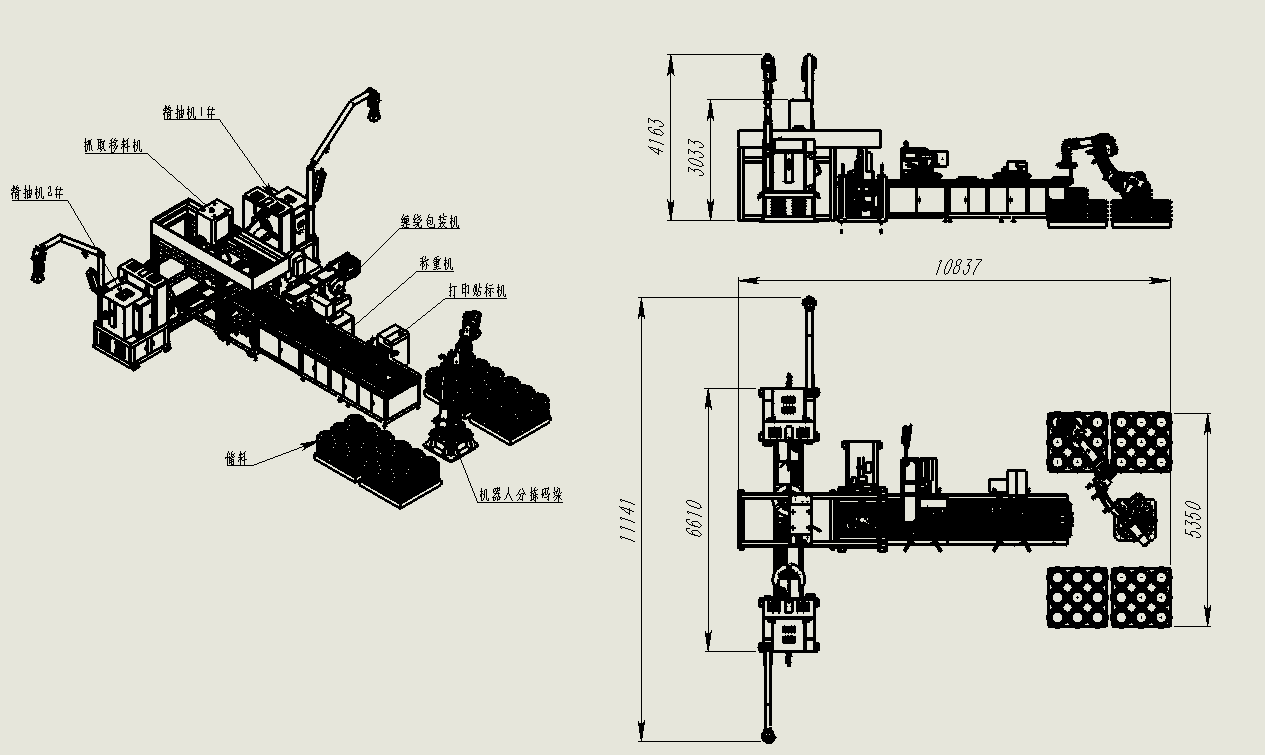
An inline steel coil packing machine is a fully integrated, automated system designed to connect directly with your existing production line, handling coils sequentially from processing to final packaging. This seamless integration allows for continuous, high-speed operation, drastically reducing labor needs, minimizing human error, and ensuring consistent product protection, thereby transforming your production by eliminating bottlenecks and significantly improving overall factory efficiency and safety.
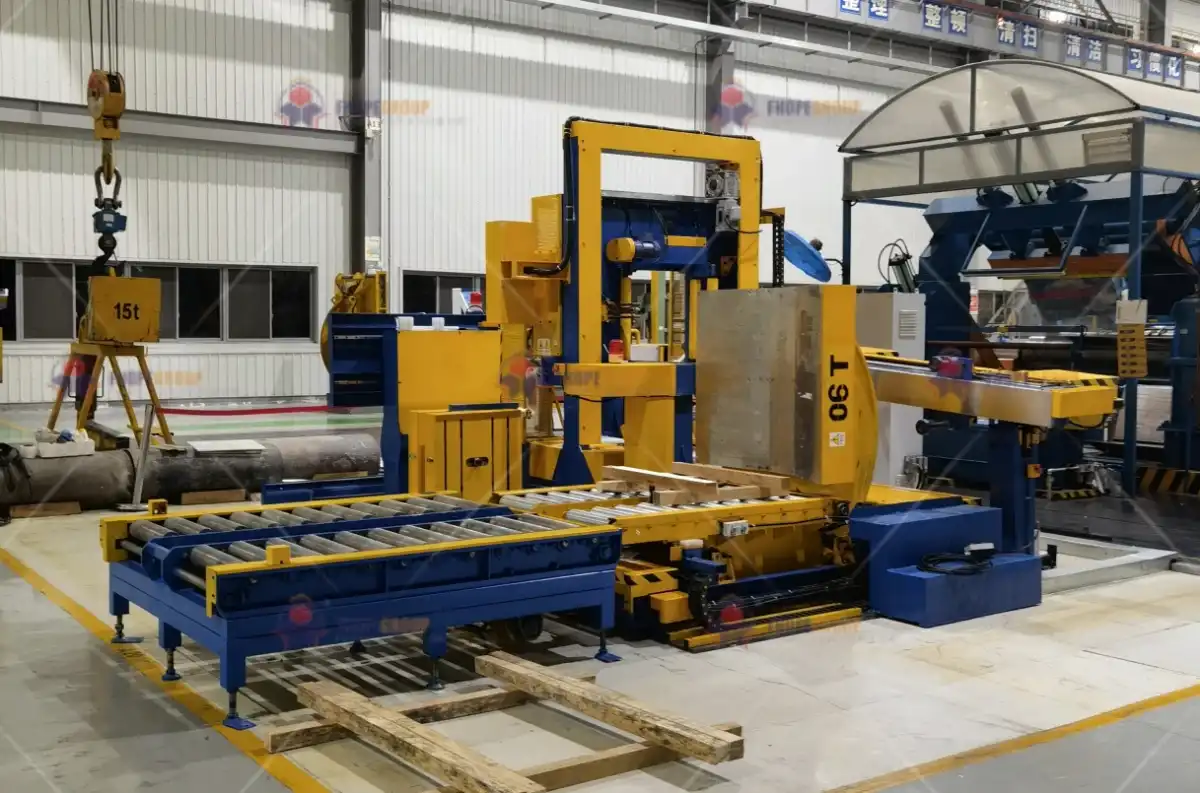
When I first started designing packing solutions, the goal was always to achieve maximum throughput with minimal manual effort. An inline system embodies this philosophy. It’s not just a single machine; it’s a complete process where multiple stages of packing—like wrapping, banding, stacking, and sometimes even weighing and labeling—are interconnected and synchronized. This creates a continuous flow, an automated packing line that truly masters the packing process. For a factory manager like Michael, this means a significant leap towards automation and efficiency, directly addressing the bottleneck at the end of the production line. It’s about ensuring your precious steel coils are packed quickly and safely, ready for shipment without delay or damage. (Integrated coil packaging automation, High-speed steel coil wrapping, End-to-end production line solutions)
The Power of Continuous Flow: Key Benefits of Inline Systems
Inline steel coil packing machines offer several compelling advantages, especially for operations with high volume and a consistent product flow. These systems are built for endurance and high performance, critical for heavy industry environments.
-
Unrivaled Efficiency and Throughput:
- Automation: Reduces reliance on manual labor, leading to fewer errors and faster packing cycles.
- Integration: Connects directly to slitting or forming lines, ensuring coils move seamlessly from production to packaging.
- Speed: Designed for continuous, high-volume output, drastically improving overall production capacity.
- Example: A factory I worked with in Mexico used to pack coils by hand. They switched to an inline system and saw a 300% increase in packing speed. This freed up their entire workforce for more skilled tasks.
-
Enhanced Safety for Workers:
- Reduced Manual Handling: Heavy lifting and maneuvering of coils are virtually eliminated.
- Controlled Environment: Operators manage the process from a safe distance, away from moving machinery and heavy loads.
- Fewer Accidents: Minimizes the risk of workplace injuries, lowering insurance costs and improving employee morale.
- 👷♂️ Safety Improvement: Less risk of back injuries from lifting.
- 🩹 Reduced Accidents: Fewer crushing incidents.
-
Superior Product Protection and Consistency:
- Precise Wrapping: Automated systems apply packaging materials consistently, ensuring optimal protection against damage during transit or storage.
- Standardized Process: Every coil is packed to the same high standard, reducing product loss and customer complaints.
- Damage Control: Protects coil edges and surfaces, preventing costly rework or scrap.
- 🔍 Quality Assurance: Uniform packaging for every product.
- 🛡️ Damage Prevention: Protects against rust and physical impacts.
-
Significant Cost Savings (Long-Term ROI):
- Labor Cost Reduction: Fewer personnel required for packing operations.
- Material Optimization: Automated systems use packing materials efficiently, reducing waste.
- Increased Uptime: Robust design ensures reliability and minimal downtime, maximizing operational hours.
- 💲 Lower Operating Expenses: Reduced wages and material usage.
- 📈 Higher Profit Margins: Through efficiency gains and reduced losses.
Inline systems are an investment in the future of your factory. They bring a level of predictability and control to your packing operations that manual processes simply cannot match. For someone like Michael, facing intense pressure to boost output and cut costs, an inline solution directly addresses both needs, providing a clear path to improved profitability. (Automated coil handling safety, Continuous packing line benefits, Industrial packaging ROI)
2. What Does a Standalone Steel Coil Packing System Offer for Flexibility and Specific Needs?
Are you running a factory where your packing needs aren’t always constant, or perhaps you need a flexible solution for various product sizes and types without completely overhauling your entire production line? Have you had issues with past equipment suppliers who only focused on sales, leaving you unsupported when problems arose? You need a partner who truly understands the nuances of your operation, not just a vendor selling a generic machine.
A standalone steel coil packing system is an independent unit designed for specific packing tasks, offering exceptional flexibility and adaptability for diverse operational requirements. Unlike inline systems, these machines operate independently, allowing them to be easily integrated into existing workflows or used for intermittent, specialized packing jobs. They provide targeted solutions for managing heavy coils or molds, enhancing safety, and improving packing quality without demanding a full-scale line overhaul, making them ideal for factories seeking focused upgrades or versatile packing capabilities.
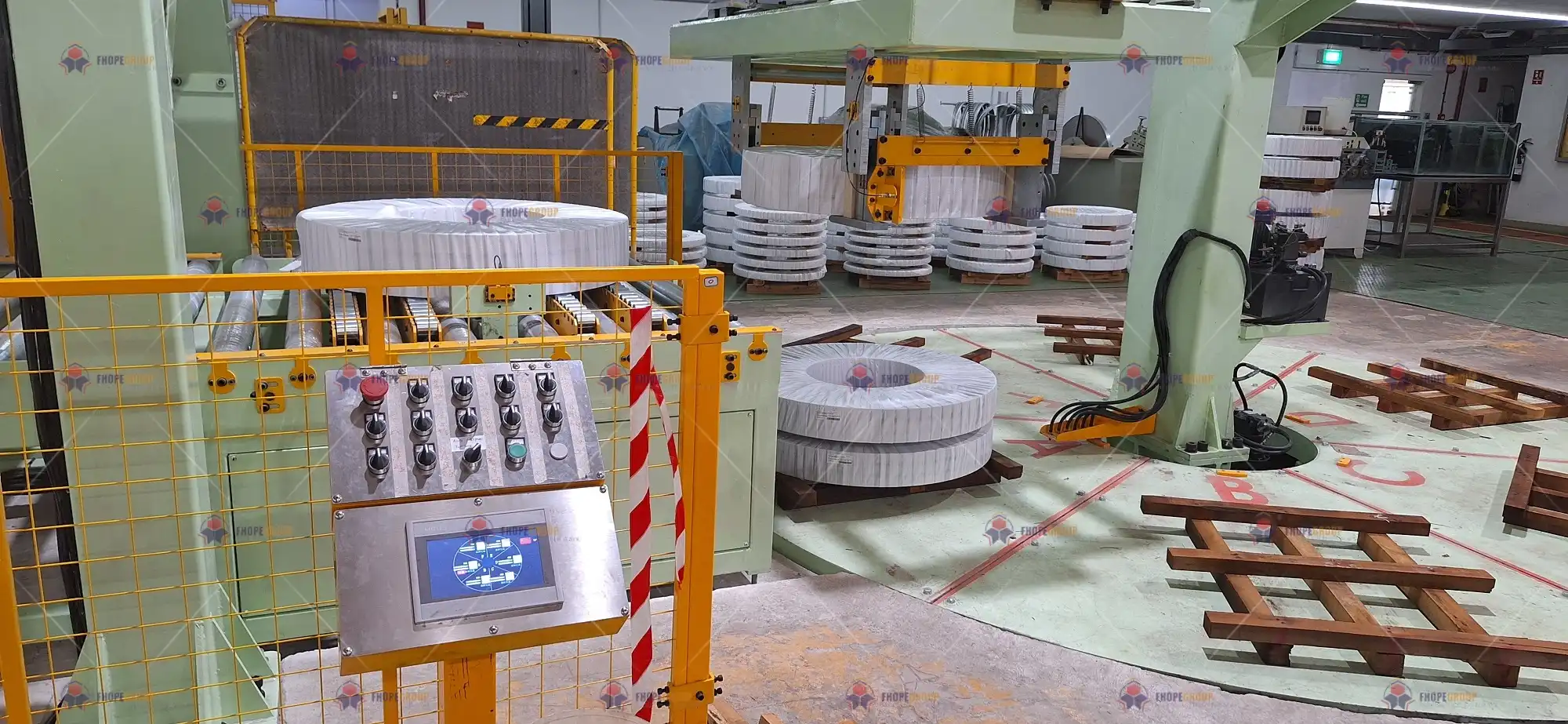
When I think about the diverse needs of factories, especially those that might not have the continuous, high-volume output of a large-scale operation, standalone systems always come to mind. They are like specialized tools in a craftsman’s kit – perfect for the job at hand without requiring a complete overhaul of the workshop. For Michael, who needs solutions that address specific bottlenecks or safety concerns, a standalone system can be a powerful, strategic investment. It can target the painful areas, like manual heavy coil handling or specific product damage points, providing immediate relief and a clear return on investment. I’ve seen these systems provide incredible value by solving acute problems without disrupting the entire factory. (Flexible coil packing solutions, Standalone heavy duty packing, Specific packing task automation)
Versatility and Targeted Solutions: Advantages of Standalone Systems
Standalone steel coil packing systems excel where flexibility, space considerations, or specific application needs are paramount. They can be strategically placed to address particular challenges.
-
Exceptional Flexibility and Adaptability:
- Modular Design: Can be integrated into various points of the production process or used as a dedicated off-line packing station.
- Versatile Application: Handles different coil sizes, weights, and types with minimal changeover time.
- Space Efficient: Often requires less floor space compared to a full inline system, suitable for factories with tighter layouts.
- Example: A client needed a specific machine just for strapping unusually large coils. A standalone strapper was the perfect fit. It gave them the capability without disrupting their main production flow.
-
Targeted Problem Solving:
- Addressing Specific Bottlenecks: Ideal for automating one problematic packing step, like wrapping or strapping, that currently relies on inefficient manual labor.
- Safety Focus: Can be deployed to eliminate manual handling of heavy items, such as large coils or even molds (as Michael mentioned), where injury risk is highest.
- Customization: Easier to customize for unique packing requirements or unusual product shapes.
- 🎯 Pinpoint Solutions: Solves specific pain points directly.
- 💪 Heavy Load Handling: Eliminates manual risks for large items.
-
Lower Initial Investment and Phased Automation:
- Cost-Effective Entry: Generally requires a lower upfront capital expenditure compared to a complete inline system.
- Gradual Implementation: Allows factories to automate in stages, investing in individual machines as budget and needs evolve.
- Scalability: Can be added to or upgraded over time as production demands increase.
- 💰 Reduced Upfront Cost: Easier budget allocation.
- 🚀 Incremental Automation: Grow your capabilities over time.
-
Simplified Maintenance and Troubleshooting:
- Independent Operation: Issues with one standalone unit do not necessarily shut down the entire production line.
- Easier Diagnostics: Troubleshooting is often simpler as the system is self-contained.
- Dedicated Support: FHOPEPACK, for instance, provides focused support for these specialized machines.
- 🔧 Easier Repairs: Isolated problems mean faster fixes.
- 🚫 Minimized Downtime Impact: Prevents system-wide shutdowns.
Standalone systems provide a practical, effective way to introduce automation and address critical operational challenges without the extensive commitment of a full inline setup. For Michael, seeking clear ROI and expert guidance, these solutions offer a strategic starting point to improve safety and efficiency where it’s needed most. (Flexible coil packaging solutions, Targeted automation for heavy items, Phased factory modernization)
3. How Do Inline and Standalone Systems Compare in Terms of Efficiency, Safety, and ROI for Your Factory?
When you’re making a significant investment in factory equipment, you need to be sure it aligns with your operational goals and delivers tangible returns. Are you constantly weighing the benefits of speed versus flexibility, or wondering which system will truly minimize product damage and maximize worker safety? You’ve dealt with suppliers who don’t understand the true cost of downtime or the critical need for a reliable partnership.
Comparing inline and standalone steel coil packing systems reveals distinct advantages in efficiency, safety, and return on investment, each suited to different operational profiles. Inline systems excel in high-volume, continuous production environments, offering unparalleled speed, seamless integration, and maximum labor reduction for superior overall efficiency and safety. Standalone systems, conversely, provide greater flexibility, lower initial investment, and targeted automation for specific bottlenecks or varied packing needs, delivering strong ROI through focused improvements in particular areas of product handling, damage reduction, and worker safety.

My journey in the packing machine industry, from an employee to building my own successful factory, taught me that every decision about equipment is a strategic one. It’s not just about the machine itself, but how it impacts your entire operation—your people, your products, and your profits. Let’s break down the comparison using the factors that matter most to a factory manager like Michael: efficiency, safety, and the all-important return on investment. I believe in providing clear insights so you can see where your money truly makes a difference. (Comparative packaging efficiency, Safety features in packing machines, Packing system ROI analysis)
Detailed Comparison: Inline vs. Standalone Steel Coil Packing Systems
Let’s look at a structured comparison to help you visualize the differences and align them with your factory’s unique situation.
| Feature | Inline Steel Coil Packing Machine | Standalone Steel Coil Packing System | Relevance for Michael Chen |
|---|---|---|---|
| Efficiency | High-volume, continuous, seamless integration with production lines. | Flexible, task-specific, suitable for intermittent or varied tasks. | Michael needs to eliminate efficiency bottlenecks. Inline for overall throughput; Standalone for specific, critical areas. |
| Automation Level | Full automation from start to finish, minimal human intervention. | Partial automation, focused on specific packing stages. | High automation for safety and consistency. Both reduce manual labor, addressing current inefficient, manual processes. |
| Safety | Maximized safety through reduced manual handling across the entire process. | Improved safety by automating specific heavy or hazardous tasks. | Both improve worker safety by reducing manual handling of heavy items (coils, potentially molds), lowering injury risk. |
| Product Protection | Consistent, standardized packaging for every coil, minimizing damage. | Focused protection for specific packing points or unique products. | Reduces product damage during transfer and packing, addressing current losses and customer complaints. |
| Initial Investment | Higher upfront cost due to complexity and integration. | Lower initial cost, making it accessible for targeted upgrades. | Needs ROI-driven investment. Inline for large-scale, long-term; Standalone for immediate, impactful improvements. |
| Flexibility | Less flexible; designed for specific, consistent product flows. | Highly flexible; adaptable to changing product types or volumes. | Michael values durability and adaptability. Standalone offers more versatility for varied production. |
| Space Requirements | Typically requires more dedicated floor space for the entire line. | Generally more compact, can be placed where needed. | Space can be a factor. Standalone is good for optimizing existing layouts. |
| Maintenance Impact | Downtime can affect the entire production flow. | Issues usually contained to the specific unit, less overall disruption. | Reliability is key. Standalone offers easier isolated maintenance, but inline minimizes overall manual intervention. |
| Target Application | Large-scale metal processing, coil service centers with high output. | Medium-sized factories, specialized coil/wire packing, diverse product ranges. | Michael manages a mid-to-large metal processing plant; his choice depends on the specific bottleneck and investment strategy. |
When considering which system is best for your Mexican factory, think about your current production volume, the consistency of your product flow, and where your biggest pain points lie. If you’re looking to overhaul your entire packing operation for maximum efficiency and have a consistent, high volume of steel coils, an inline system is a powerful contender. If your factory has specific bottlenecks, varied product types, or you’re looking for a more gradual, targeted approach to automation, a standalone system can provide immediate, impactful solutions. My experience shows that sometimes a combination of both, strategically deployed, can yield the best results. (Factory automation strategy, Coil packaging comparison, Metal industry equipment decisions)
4. How Can You Choose the Best Steel Coil Packing Solution to Drive Your Factory’s Growth and Address Your Unique Challenges?
You’ve explored the options, but the real question remains: how do you translate this knowledge into a concrete decision that truly benefits your factory in Mexico? You’re not just buying a machine; you’re looking for a partner who understands your challenges—your efficiency bottlenecks, safety concerns, and the need for a clear return on investment. How do you find a supplier you can trust after past disappointments with inadequate after-sales service?
Choosing the best steel coil packing solution—whether inline or standalone—requires a thorough assessment of your factory’s specific production volume, space constraints, budget, and most importantly, a clear understanding of your current challenges and future growth objectives. It involves identifying your most pressing efficiency bottlenecks, safety hazards, and product damage points, then partnering with an experienced expert like me, who can provide tailored guidance and reliable, ROI-driven solutions to ensure your investment truly drives your factory’s growth and profitability, offering comprehensive support beyond the initial sale.
From my early days working on the factory floor to establishing FHOPEPACK, I learned that the right equipment is only half the battle. The other half is the expertise and partnership behind it. For Michael, selecting a packing solution isn’t just about technical specifications; it’s about finding a relationship that fosters trust and delivers tangible results. This is where FHOPEPACK steps in. We don’t just sell machines; we share knowledge and provide solutions rooted in real-world factory experience. Here’s how you can make that critical decision, ensuring your factory not only meets its targets but thrives. (Optimizing factory packing, Selecting industrial packaging, Trustworthy equipment partners)
Making the Right Choice: A Strategic Decision Framework
To ensure your investment in a steel coil packing system delivers maximum value, follow a structured approach that considers all critical aspects of your operation.
-
Step 1: Assess Your Current Operations and Identify Pain Points
- Production Volume: How many coils do you process daily, weekly, monthly? Is your volume consistent or does it fluctuate?
- Current Bottlenecks: Where do delays occur in your packing process? Is it manual handling, wrapping, strapping, or transport?
- Safety Hazards: Pinpoint specific tasks involving heavy lifting or hazardous environments, especially for coils or heavy molds.
- Product Damage Points: Where and how are your products getting damaged during internal transfer or packing?
- 💡 Self-Assessment: Clearly define your problem areas.
- 📊 Data Collection: Quantify current output and losses.
-
Step 2: Define Your Goals and Desired Outcomes
- Efficiency Targets: What percentage increase in packing speed or overall throughput do you aim for?
- Safety Improvements: How do you envision minimizing manual labor and reducing injury risks?
- Cost Reductions: What are your targets for lowering labor costs, reducing material waste, and decreasing product loss?
- Long-Term Vision: How will this investment support your factory’s growth and automation strategy over the next 5-10 years?
- 🚀 Future Vision: Set clear, measurable objectives.
- 💰 Financial Goals: Determine your desired ROI.
-
Step 3: Evaluate System Options Against Your Needs
- Inline System Suitability: Ideal if you have high, consistent volume, sufficient space, and aim for end-to-end automation.
- Standalone System Suitability: Best if you need flexibility, targeted solutions for specific bottlenecks, or have limited space/budget for a full line.
- Space & Integration: Consider how each system fits into your existing factory layout and production flow.
- Budget & ROI: Analyze the initial investment, ongoing operational costs, and the projected return on investment for each option. My experience has shown that sometimes a slightly higher initial investment in robust equipment pays off immensely in reduced downtime and maintenance.
Decision Factor Inline System Standalone System Volume High, consistent Varied, intermittent, lower Integration Seamless, directly into production Flexible, adaptable to existing setups Space More required, dedicated line Less, can be placed strategically Initial Cost Higher Lower Primary Benefit Maximum throughput, full automation Targeted problem-solving, flexibility -
Step 4: Seek Expert Guidance and Partnership
- Industry Experience: Look for a partner with deep, practical experience in packing machines and factory operations, like what I offer at FHOPEPACK. I’ve built factories from the ground up and helped many clients grow their businesses, so I understand your perspective.
- Solution-Oriented Approach: Does the supplier focus on understanding your challenges and offering tailored solutions, or just selling a product?
- After-Sales Support: Crucial for long-term success. Ensure reliable service, spare parts availability, and technical assistance. This is where many suppliers fall short, and it’s something I prioritize at FHOPEPACK.
- 🤝 Collaborative Approach: Partner with someone who genuinely understands your business.
- 📞 Reliable Support: Ensure ongoing technical assistance.
Choosing the right steel coil packing solution is a strategic move that can significantly impact your factory’s efficiency, safety, and profitability. By following these steps and leveraging expert insights, you can make a decision that not only addresses your current challenges but also propels your business towards a more automated, safer, and prosperous future. (Factory growth strategies, Industrial equipment partnership, ROI-driven automation)
Conclusion
Choosing between an inline and a standalone steel coil packing system is a strategic decision for your factory. It hinges on your unique needs for efficiency, safety, and ROI. With FHOPEPACK, you gain a partner dedicated to sharing expertise for optimizing your steel coil packing line.


