Automatic vs Semi-Automatic Steel Coil Packing Machines — What’s the Difference?
Are you a factory manager, like Michael, struggling with a packing line that just cannot keep up? Do you see your team manually handling heavy steel coils, facing slow speeds, safety risks, and even product damage? I know these challenges well. For years, I have seen operations just like yours, trying to balance output, safety, and costs. The right packing machine can change everything, but choosing between automatic and semi-automatic can be confusing.
The main difference between automatic and semi-automatic steel coil packing machines lies in the level of human intervention required. An automatic machine performs the entire packing process – from feeding to wrapping and sealing – with minimal or no human oversight. A semi-automatic machine, on the other hand, still needs an operator to load the coil, initiate the cycle, or perform certain manual steps during the packing process, offering a blend of machine power and human control for diverse production needs.

Making the wrong choice can mean missed targets, higher costs, and ongoing headaches. But with the right knowledge, you can make a decision that transforms your packing line into a reliable, efficient, and safe operation. Let’s break down each option, helping you understand which one best fits your factory’s unique demands.
1. What is an Automatic Steel Coil Packing Machine, and How Does it Benefit My Factory?
Are you tired of bottlenecks at the end of your production line? Does the idea of a fully automated process, where steel coils move smoothly from production to a perfectly packaged state, sound like a dream? Many factory managers, including those managing metal processing plants, face immense pressure to boost output and cut down on manual labor costs. An automatic packing machine could be the answer to these pressures.
An automatic steel coil packing machine is a complete system that handles every step of the packing process without human intervention. This includes feeding the coil, positioning it, applying wrapping materials, securing the package, and sometimes even weighing and labeling. These machines integrate seamlessly into existing production lines, ensuring continuous, high-speed operation and consistent packaging quality.
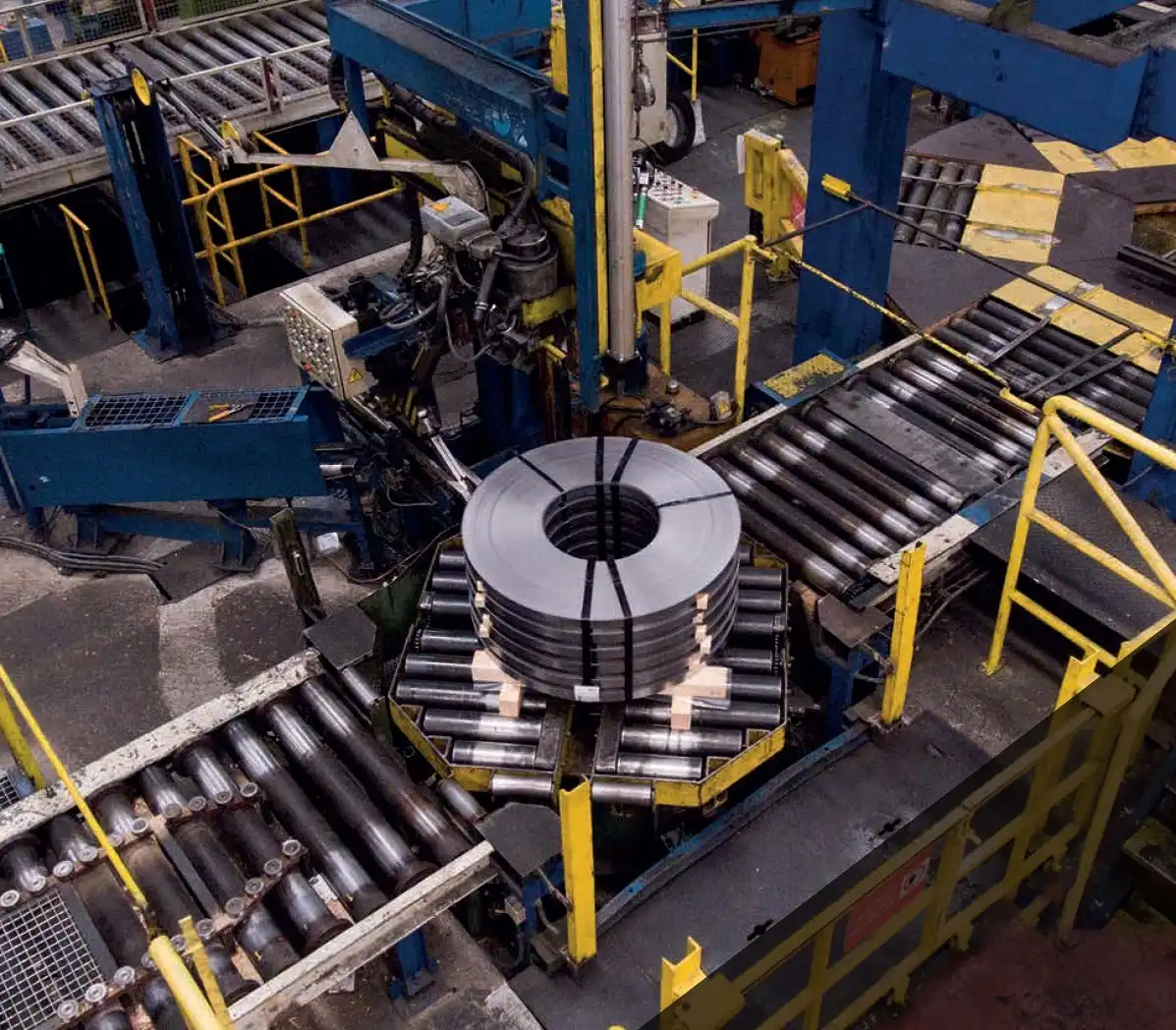
From my experience designing and running packing machine factories, I have seen firsthand how automation can revolutionize an operation. When we talk about "automatic" in the context of steel coil packing, we mean machines that take over the entire workflow. Imagine coils moving on conveyors, entering a wrapping station, getting tightly secured with stretch film or plastic bands, and then being discharged, all without someone needing to touch them. This kind of setup includes sophisticated controls, sensors, and sometimes robotics to ensure precision and speed. It handles various coil sizes, from heavy steel coils to delicate wire coils, always maintaining a high standard. This level of automation is critical for factories aiming for high throughput and looking to modernize their processes. It addresses common pain points like slow manual processes and inconsistent packaging quality that often lead to customer complaints. (automated coil packaging systems, high-speed coil wrapping, integrated packing solutions)
What Does "Automatic" Really Mean?
An automatic packing machine is more than just a single piece of equipment. It is a system. It includes:
- Conveyors: To move coils in and out.
- Centering Devices: To position the coil correctly for wrapping.
- Wrapping Heads: To apply film, paper, or other materials.
- Strapping Units: To secure the package.
- Control Systems: A central brain that manages the entire sequence.
The machine takes a coil, wraps it, straps it, and prepares it for shipment or storage. All of this happens automatically. Operators monitor the system, replenish materials, and handle maintenance. They do not perform the physical packing steps. This is a game-changer for high-volume producers, allowing for significant improvements in overall equipment effectiveness.
Key Benefits for Your Operations
Implementing an automatic system brings many advantages, especially for operations like Michael’s factory in Mexico, which handles large volumes of metal.
- 📈 Increased Throughput & Speed:
- Automatic machines operate at much higher speeds than human workers. This means you can pack more coils per hour or per shift. This directly solves bottlenecks that slow down your entire production, making sure your products get to customers faster.
- For example, a machine can complete a coil wrap in minutes, something that might take several people much longer.
- 🛡️ Enhanced Safety:
- This is a huge one. Michael mentioned the high risk of injury from manually handling heavy coils. Automatic systems remove workers from dangerous tasks. There is no need for people to lift, turn, or secure heavy coils. This reduces workplace accidents, lowers insurance costs, and creates a much safer environment for your employees.
- It minimizes the chances of strain injuries, crushed limbs, or falls, which are common in manual heavy lifting.
- 💰 Significant Cost Savings:
- While the initial investment is higher, the long-term savings are substantial. You need fewer operators for the packing process. This cuts down on labor costs. Also, consistent machine operation reduces material waste and product damage. Less product damage means fewer customer returns and claims, directly impacting your bottom line.
- The return on investment (ROI) often comes from reduced labor, material efficiency, and improved product quality.
- ✨ Consistent Quality:
- Machines apply wrapping materials with uniform tension and coverage every time. This ensures a consistent, professional-looking package. It protects your products, like steel coil edges, from damage during transit or storage. This consistency leads to fewer complaints and happier customers.
- It maintains brand reputation and ensures products meet stringent quality standards.
- Imagine every coil leaving your factory with the same high-quality wrap, regardless of the shift or operator. That is what automation delivers.
- (reducing packing labor, automated coil handling, consistent package quality, manufacturing efficiency)
2. What is a Semi-Automatic Steel Coil Packing Machine, and When is it the Right Choice?
Perhaps a full automation system feels like a huge leap or a significant financial commitment right now. Many businesses look for solutions that improve efficiency and safety without requiring a complete overhaul of their existing processes. If you are seeking a middle ground, a solution that still involves human skill but provides a big boost in performance, then a semi-automatic machine might be exactly what you need.
A semi-automatic steel coil packing machine combines the power and consistency of machinery with the flexibility and oversight of a human operator. In this setup, the machine handles specific parts of the packing process, such as the actual wrapping or strapping, while a worker manually loads the coil, initiates the packing cycle, or positions the material. This balance makes semi-automatic systems ideal for factories with varied product lines, moderate production volumes, or those looking to incrementally improve their packing operations.
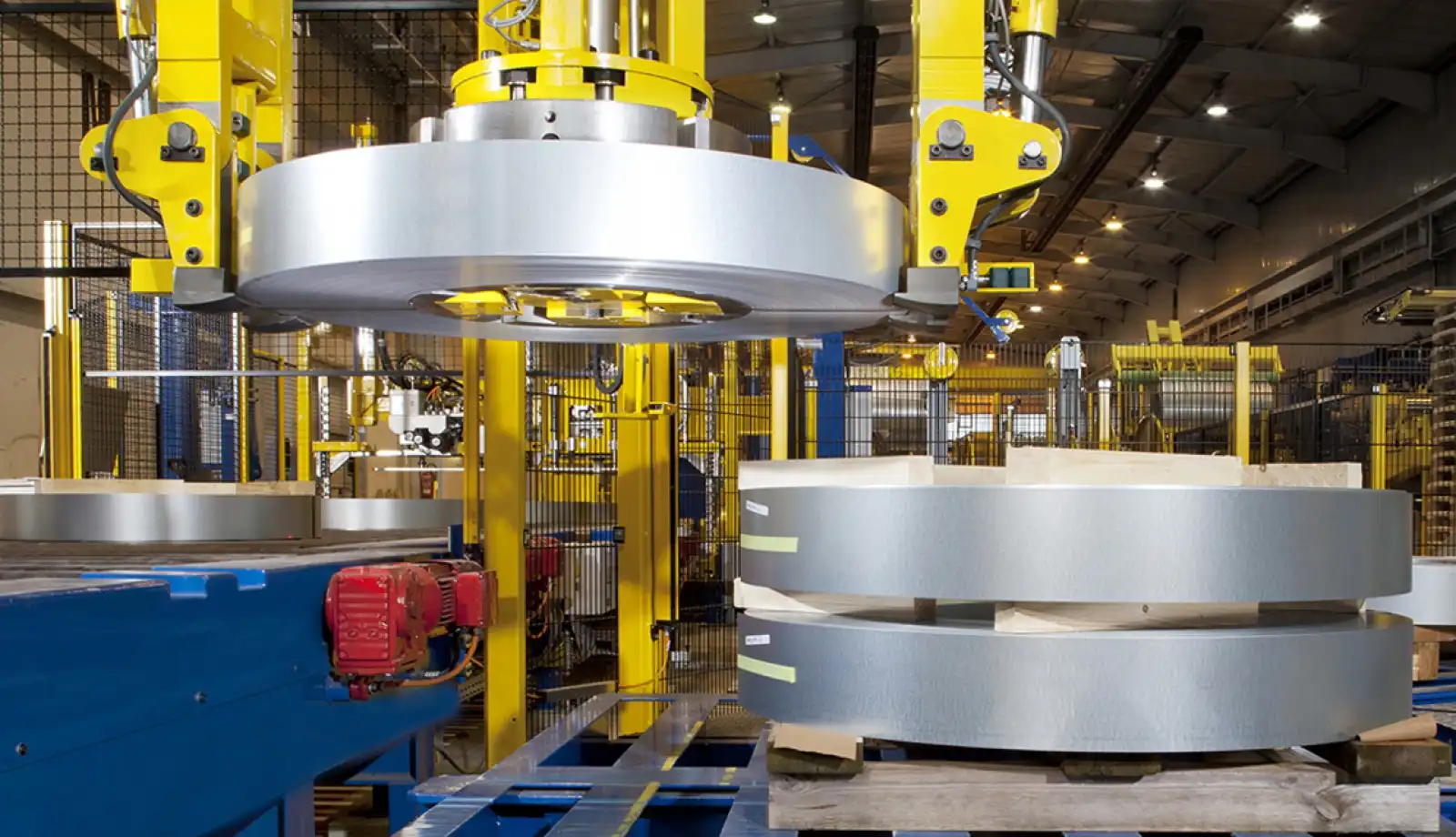
When I started FHOPEPACK, I understood that not every factory has the same needs or budget. A semi-automatic machine often bridges the gap between purely manual methods and full automation. It is a great starting point for improving safety and efficiency without the top-tier investment of a fully automated line. For example, an operator might use an overhead crane to load a coil onto the machine’s platform, press a button to start the wrapping cycle, and then manually unload the finished package. This hybrid approach allows for better control over varied coil types or lower production volumes, where the full speed of an automatic system might be overkill. It still significantly reduces the most strenuous and dangerous manual tasks, improving worker safety and overall flow. (hybrid packing solutions, flexible coil wrappers, cost-effective automation, manual assist packing)
The Hybrid Approach: Human & Machine
Semi-automatic systems strike a balance. They automate the physically demanding and repetitive tasks, while keeping humans in control for other parts.
- Operator Involvement: Workers load the coil onto the machine, select packing parameters, and start the wrapping process. They also often manage material replenishment.
- Machine Function: The machine then performs the actual wrapping or strapping. It applies the film or bands with consistent tension and speed.
- Partial Automation: This setup is faster and safer than purely manual packing. It is also more adaptable to different product specifications or smaller batch sizes.
It is a stepping stone for many businesses. They get automation where it matters most, without losing human adaptability.
Advantages of Semi-Automatic Systems
Semi-automatic machines offer distinct benefits, making them a sensible choice for specific factory environments.
- 📉 Lower Initial Investment:
- These machines cost less to buy and install than fully automatic systems. This makes them more accessible for factories with tighter budgets or those that want to test automation without a large upfront expense.
- It reduces financial risk and allows for a more gradual investment in technology.
- 💪 Flexibility:
- Because an operator is involved, semi-automatic machines can handle a wider range of coil sizes, weights, and shapes more easily. If your factory produces many different kinds of coils or has variable production runs, this flexibility is a major advantage.
- It adapts well to custom orders or unusual product dimensions without complex reconfigurations.
- 🚧 Improved Safety (Compared to Fully Manual):
- Even though there is still human interaction, the machine takes over the most dangerous and physically demanding parts, like the actual wrapping and rotating of heavy coils. This greatly reduces the risk of strain, repetitive motion injuries, and accidents compared to a fully manual process.
- It is a significant upgrade in worker safety from traditional methods.
- ⬆️ Stepping Stone to Full Automation:
- For factories considering full automation in the future, a semi-automatic machine can be a great first step. It allows your team to get familiar with automated equipment and processes. This prepares your workforce for more advanced systems down the road, making future transitions smoother.
- It helps an organization mature its operational processes incrementally.
- (small scale coil packing, flexible packaging solutions, budget-friendly wrappers, ergonomic packing improvements)
3. Automatic vs. Semi-Automatic: A Side-by-Side Comparison for My Production Line?
Choosing the right packing machine is a big decision for any factory manager focused on operations, like Michael. It impacts your daily output, your budget, and the safety of your team. The choice between automatic and semi-automatic systems is not about one being inherently better than the other. It is about which one aligns best with your specific production volume, investment capacity, and long-term goals. Let’s look at how they stack up against each other.
When comparing automatic and semi-automatic steel coil packing machines, automatic systems offer higher speed, lower labor costs, and superior safety for high-volume, consistent production, but with a larger initial investment. Semi-automatic machines provide greater flexibility, a lower entry cost, and improved safety over manual methods, making them suitable for moderate volumes, varied product types, or as a transitional solution towards full automation.

My journey from a factory employee to building FHOPEPACK has taught me that every operational decision has a ripple effect. When evaluating these machines, think about your factory’s pulse. How many coils move through your line daily? How consistent are their sizes? What is your budget today, and what do you want your factory to look like in five years? This comparison will help you identify the system that truly master your packing machine needs, ensuring you invest wisely in equipment that supports your business growth and operational excellence. (packing machine comparison, industrial equipment evaluation, high volume vs flexible packing, long-term operational planning)
Key Decision Factors
When I advise clients, we always look at several crucial areas. These help us decide the best fit.
- 💸 Investment Cost:
- Automatic: High. These systems involve more complex machinery, sensors, and integration.
- Semi-Automatic: Moderate. Lower initial cost, making it easier to start.
- ⚙️ Operational Efficiency:
- Automatic: Very High. Designed for continuous, high-speed production. Minimal downtime for material changes or adjustments.
- Semi-Automatic: Medium. Faster than manual, but human interaction introduces pauses and limits peak speed.
- 👷 Labor Requirements:
- Automatic: Low. Operators primarily monitor, replenish materials, and maintain the system. Significant reduction in direct labor.
- Semi-Automatic: Medium-High. Still needs operators for loading, unloading, and initiating cycles.
- 🚨 Safety Impact:
- Automatic: Excellent. Eliminates almost all manual handling of heavy coils, greatly reducing injury risk.
- Semi-Automatic: Good. Reduces many high-risk tasks compared to full manual, but some manual interaction remains.
- 📈 Scalability & Future Growth:
- Automatic: High. Easily integrates into fully automated production lines, ready for future expansion.
- Semi-Automatic: Medium. Can be a stepping stone, but scaling up might require replacing the system entirely later.
- 📏 Product Variety & Volume:
- Automatic: Best for high-volume, consistent product sizes. Less flexible for frequent changes.
- Semi-Automatic: More flexible for varied product sizes, shapes, and lower production volumes.
Comparison Table
| Feature | Automatic Steel Coil Packing Machine | Semi-Automatic Steel Coil Packing Machine |
|---|---|---|
| Initial Investment | High (complex systems, advanced technology) | Moderate (simpler design, fewer integrated components) |
| Throughput (Speed) | Very High (continuous, rapid operation, minimal human breaks) | Medium (faster than manual, but limited by operator interaction) |
| Labor Needs | Low (supervisory role, material replenishment) | Medium-High (requires operator for loading, starting, unloading) |
| Worker Safety | Excellent (removes humans from direct interaction with heavy coils) | Good (reduces high-risk manual tasks, but some interaction remains) |
| Flexibility | Low to Medium (best for standardized products, less for variety) | High (adapts well to varied coil sizes, shapes, and production runs) |
| Product Consistency | Very High (uniform wrap, precise tension every time) | High (machine ensures consistency during automated steps) |
| ROI Period | Longer (due to higher initial cost, but greater long-term savings) | Shorter (lower initial cost, quicker payback, but less overall savings) |
| Ideal For | Large factories, high-volume production, consistent products | Medium factories, varied products, moderate volume, budget constraints |
(production line efficiency, packaging automation cost, labor reduction strategies, industrial safety comparison)
4. How Do I Choose the Right Steel Coil Packing Machine for My Factory’s Specific Needs?
Making the right equipment investment can be daunting, especially given past negative experiences with suppliers who only care about the sale. I understand that a factory manager like Michael needs a partner, not just a vendor. The choice of a packing machine is a long-term commitment that impacts your entire operation. It is about finding a solution that genuinely solves your problems and helps you grow. So, how do you make an informed decision that truly benefits your factory?
To choose the right steel coil packing machine, you must first assess your current production volume, coil dimensions, existing safety challenges, and budget. Then, look for a supplier who acts as a true partner, offering deep industry expertise, reliable after-sales support, and customized solutions that directly address your factory’s unique needs, ensuring a strong return on investment and seamless integration.
At FHOPEPACK, my team and I believe in understanding your world first. My own journey, starting on the factory floor and building a successful packing machine business, taught me the true value of empathy and expertise. We do not just sell machines; we help you find solutions that address your efficiency bottlenecks, safety hazards, product loss issues, and rebuild your trust in equipment partners. We guide you through the process, ensuring the equipment you choose genuinely supports your goals. (factory manager solutions, ROI for packing equipment, trusted equipment supplier, customized packaging systems)
Assessing Your Current Production
Before you even look at machines, you need to look at your own operation.
- 🔢 Volume & Throughput: How many steel coils do you produce and need to pack per hour, day, or shift?
- High volume, consistent products: Lean towards automatic.
- Moderate volume, varied products: Semi-automatic might be better.
- ⚖️ Coil Dimensions & Weight: What are the typical, minimum, and maximum sizes and weights of the coils you handle?
- Machines have specific ranges they can accommodate. Ensure the chosen system can handle your full product spectrum.
- ⚠️ Current Safety Gaps: Where are the biggest risks in your current packing process?
- Identify points where manual handling leads to injuries or fatigue. This helps you prioritize solutions that directly improve worker safety.
- 💸 Budget & ROI Expectations: What is your budget for this investment, and what kind of return do you expect?
- Consider not just the machine cost but also installation, training, and maintenance. Calculate potential savings from reduced labor, material waste, and improved product quality.
Finding a True Partner (Not Just a Vendor)
This is where FHOPEPACK stands out. My experience has shown me that trust is paramount.
- 🤝 The FHOPEPACK Difference:
- I founded FHOPEPACK to share my expertise. We understand the pressures you face—the need for higher output, lower costs, and strict safety. We do not just offer equipment; we offer insights and solutions based on real-world factory experience. My team and I have walked in your shoes. We know what works. We know how to integrate systems into existing lines without disrupting your entire operation.
- We listen to your specific problems. We help you map out your current bottlenecks and design a solution. This approach is what helps our clients grow their businesses, just as it helped me achieve financial independence through the packing machine industry.
- 🛠️ After-Sales Support & Training:
- A machine is only as good as its support. A true partner provides comprehensive training for your staff. They offer responsive and reliable technical support and spare parts availability. This ensures your machines run smoothly for years, minimizing costly downtime.
- 💡 Customization & Integration:
- Every factory is unique. The best partner offers solutions that can be customized to fit your specific floor plan, production line, and coil types. They should be able to integrate new equipment seamlessly with your existing machinery. When we recommend solutions at FHOPEPACK, we prioritize robust and proven technology. For instance, when it comes to high-performance components or full system integrations, we often work with reputable manufacturers. We ensure you get solutions that are tailored to your needs and built to last.
- (packing machine selection guide, industrial automation consultation, after-sales service importance, custom packaging solutions)
Conclusion
Choosing between automatic and semi-automatic steel coil packing machines depends on your factory’s specific needs, volume, and budget. At FHOPEPACK, we partner with you to find the ideal steel coil packing line solution, ensuring efficiency, safety, and profitability for your business.


