Automatic vs Semi-Automatic Steel Coil Packing Machine — Key Differences Explained
Have you ever felt the pressure of a bottleneck at the end of your production line? In heavy industries, especially with steel coils or wire, manual packing often becomes that bottleneck. It slows down everything, risks worker safety, and can even damage your valuable products before they leave the factory. As a factory manager, you know these issues hit your profit margins hard and create endless headaches. But what if there was a better way to master your packing process?
Automatic steel coil packing machines handle the entire packing process with minimal human input, often controlled by a PLC, from wrapping to strapping. In contrast, semi-automatic systems automate key steps like wrapping but still require significant manual intervention for tasks such as loading coils, initiating the wrap, or positioning materials. The fundamental difference lies in the level of human involvement and the overall integration of the packing line, directly impacting speed, safety, and labor costs.
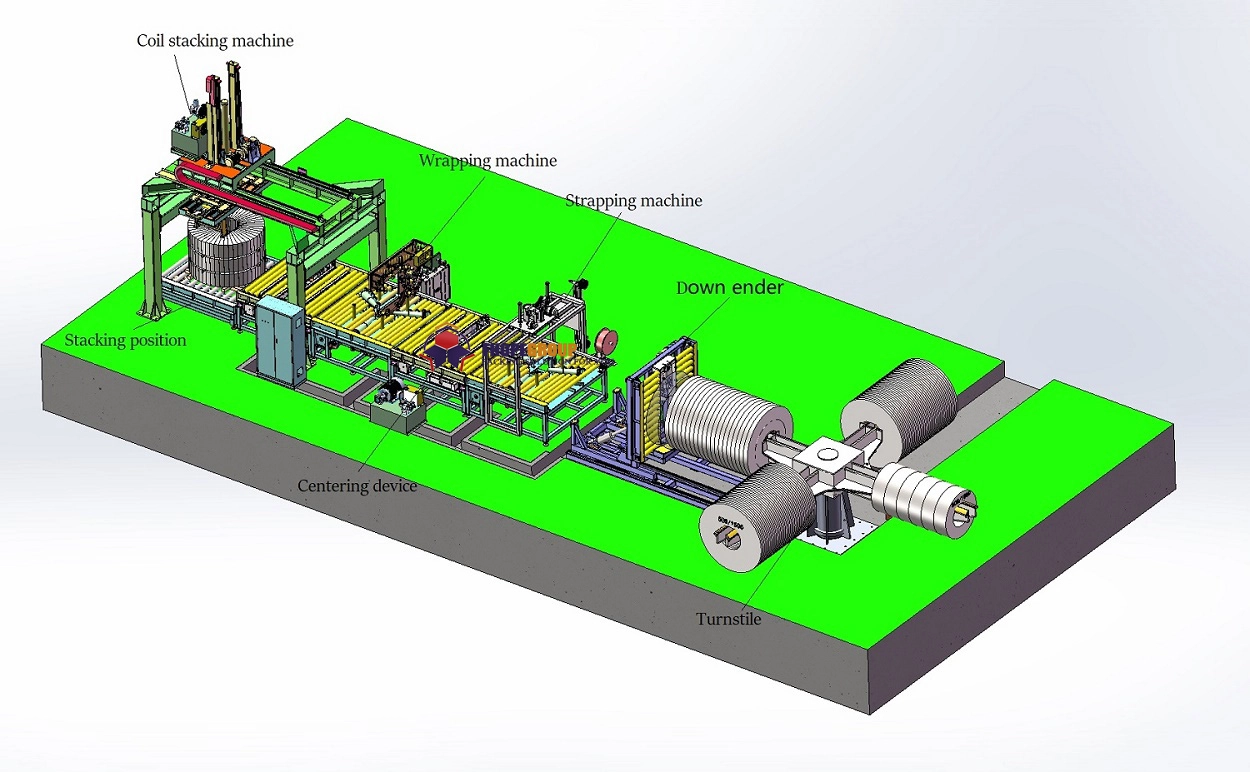
Understanding these differences is crucial for anyone looking to optimize their operations, whether you’re in a busy metal processing plant in Mexico or anywhere else in the world. Let’s dive deeper into what these machines really are and how they can transform your factory’s efficiency and safety.
1. What Exactly Are Automatic and Semi-Automatic Steel Coil Packing Machines?
Are you feeling overwhelmed by the technical jargon when exploring new industrial equipment? It’s easy to get lost in specifications. But at its core, understanding these machines is about understanding how much work they do for you.
Automatic steel coil packing machines integrate seamlessly into a production line, autonomously performing all packing tasks, including loading, conveying, wrapping, strapping, weighing, and even stacking, without constant human oversight. Semi-automatic machines, however, automate the main wrapping or strapping functions but depend on an operator to manually load the coil, position it correctly, start the packing cycle, and often unload the finished product.

Let me explain this more clearly. When I started my journey in packing machine factories, I saw first-hand how these systems evolved. An automatic system is like having a perfectly coordinated team of robots working nonstop. It picks up the steel coil, measures it, wraps it tightly with protective film or paper, applies strapping, and then moves it to the next stage, all on its own. This entire process is managed by a central control unit, ensuring consistency and speed. Think of it as a complete "hands-off" solution once the system is configured.
Semi-automatic machines offer a different approach. They provide significant help, but they still need a human touch. Imagine an operator using a crane or forklift to place a heavy steel coil onto a wrapping station. The machine then performs the wrapping or strapping efficiently. Once that’s done, the operator steps in again to remove the packed coil. It’s a powerful tool, but it works with a person, not entirely instead of one. This approach can be very effective for factories with varied product sizes or lower production volumes. You get the benefit of machine power for the repetitive, strenuous tasks, but keep the flexibility of human judgment for handling and supervision. Both types aim to improve your packing process, but they do it in different ways, addressing different operational needs and budgets.
| Feature | Automatic Steel Coil Packing Machine | Semi-Automatic Steel Coil Packing Machine |
|---|---|---|
| Human Involvement | Minimal (monitoring, maintenance) | Significant (loading, unloading, operating) |
| Speed/Throughput | High, consistent | Moderate, depends on operator |
| Process Integration | Fully integrated into production line | Standalone unit, requires manual feeding |
| Functions | Wrapping, strapping, conveying, weighing, etc. | Primarily wrapping or strapping |
| Cost | Higher initial investment | Lower initial investment |
| Ideal For | High volume, consistent product flow | Lower to medium volume, varied products |
| Safety | High (minimizes human-machine interaction) | Moderate (reduces some manual handling risk) |
(Packing machine types, industrial packing automation)
2. How Do Automatic and Semi-Automatic Systems Impact Efficiency and Safety in Steel Coil Packing?
As a factory manager like Michael in Mexico, you know that efficiency and safety are not just buzzwords; they are critical to your factory’s survival and growth. Every minute of downtime, every workplace injury, chips away at your bottom line and your reputation.
Automatic systems dramatically boost throughput by eliminating manual bottlenecks, ensuring consistent packing speeds, and improving overall production flow. They also significantly enhance safety by removing workers from direct interaction with heavy, moving steel coils, thereby minimizing the risk of accidents and injuries. Semi-automatic machines offer some efficiency gains and safety improvements over purely manual methods but still rely on human intervention, which means they retain some of the associated risks and speed limitations.

From my experience on the factory floor, I’ve seen how much manual packing can slow things down. Imagine your coils piling up at the end of the line because your team can’t wrap them fast enough. That’s a classic efficiency bottleneck. Automatic systems are designed to solve this directly. They can run continuously, often at much higher speeds than any human operator, ensuring a steady flow of packed products. This means your entire production line can move faster, leading to higher overall output. You reduce the need for multiple workers dedicated solely to packing, freeing them up for other tasks or reducing your labor costs. This is about making your entire operation leaner and more productive.
Regarding safety, this is where automatic systems truly shine. Manually handling heavy steel coils, especially when they need to be lifted, moved, or turned, is incredibly dangerous. There’s always the risk of crushing injuries, falls, or strains. Michael, you mentioned the high injury risk and rising insurance costs. Automatic coil packing machines put a significant distance between your workers and these heavy, potentially dangerous materials. Workers can oversee the process from a safe distance, intervening only when necessary for maintenance or troubleshooting. This dramatically reduces the potential for accidents. Semi-automatic machines also improve safety by automating the most hazardous part (the wrapping itself), but since operators still need to load and unload heavy coils, some risks remain. However, they are still a vast improvement over fully manual methods.
The Impact on Your Workforce and Throughput
- Automatic Systems:
- ⚡ Increased Throughput: Consistent, high-speed operation means more coils packed per hour.
- 👷 Enhanced Worker Safety: Minimal direct interaction with heavy coils dramatically lowers injury risk.
- 📉 Reduced Labor Dependence: Fewer personnel needed for packing tasks.
- ⏱️ Less Downtime: Predictable performance, less prone to human error or fatigue.
- Semi-Automatic Systems:
- 📈 Moderate Throughput Boost: Faster than manual, but still tied to operator speed.
- 🩹 Improved Safety (Partial): Reduces direct exposure to wrapping, but loading/unloading still carries risk.
- 👥 Continued Labor Need: Requires dedicated operators for each machine.
- 🔄 Operational Flexibility: Good for varying coil sizes or less consistent production schedules.
(Packing line efficiency, industrial safety standards, heavy manufacturing throughput)
3. What Are the Cost Implications and ROI for Each Packing Machine Type?
When you consider new equipment for your factory, the first question in your mind is always about the bottom line: "What will this cost, and when will I see a return?" This is a practical and essential question that every successful factory manager, like Michael, must ask.
Automatic steel coil packing machines typically have a higher initial investment due to their advanced technology, integration capabilities, and robust construction. However, they offer a faster and more substantial return on investment (ROI) through significant long-term savings in labor costs, reduced product damage, improved packing material efficiency, and vastly increased production throughput. Semi-automatic systems have a lower upfront cost, making them more accessible for factories with tighter budgets, but their ROI is realized over a longer period because they still require ongoing labor and offer more moderate efficiency gains.

My journey from an employee to owning a packing machine factory taught me that upfront costs don’t tell the whole story. An automatic system, while more expensive to purchase, can quickly pay for itself. Think about Michael’s challenges: high labor costs for manual packing and product damage during internal transfer. An automatic system directly addresses both. It can drastically reduce the number of people needed for packing, translating into substantial salary and benefits savings over time. Furthermore, consistent and secure machine packing minimizes damage to coil edges, preventing costly customer complaints and product write-offs. These savings, combined with the ability to pack more coils faster, contribute to a clear and measurable ROI. Some of my clients have seen their investment return in just a few years, allowing them to reinvest and grow their businesses even more rapidly.
Semi-automatic machines offer a different financial pathway. Their lower purchase price makes them attractive if you have a limited budget or if you’re just starting to automate. You’ll still see savings compared to fully manual methods, especially in labor and improved packing quality. However, because you still need operators, the long-term labor savings won’t be as dramatic as with a fully automatic system. The efficiency gains are also present but less pronounced, as the overall speed is still influenced by human operators. When calculating ROI, it’s crucial to look beyond just the initial price tag. Consider the total cost of ownership over 5 to 10 years, including labor, maintenance, potential for product damage, and the value of increased production capacity. Sometimes, paying more upfront for a fully automated system can lead to significantly greater long-term profitability and a competitive edge.
Cost Breakdown and ROI Comparison
- Initial Investment:
- 💸 Automatic: Higher (complex machinery, integrated systems).
- 💰 Semi-Automatic: Lower (simpler, less integration).
- Operating Costs:
- Automatic:
- ↓ Labor Costs: Significant reduction in personnel.
- ↑ Energy/Maintenance: Potentially higher for complex systems.
- ↓ Product Damage: Near-zero due to consistent handling.
- Semi-Automatic:
- ↔️ Labor Costs: Still requires dedicated operators.
- ↓ Energy/Maintenance: Generally lower due to simpler design.
- ↔️ Product Damage: Reduced compared to manual, but human error still a factor.
- Automatic:
- Return on Investment (ROI):
- 🚀 Automatic: Faster ROI, driven by massive labor savings, increased output, and damage reduction.
- 🐢 Semi-Automatic: Slower ROI, due to ongoing labor needs and moderate efficiency gains.
(Packing machine ROI, industrial equipment cost, manufacturing profitability)
4. How Do I Choose the Right Steel Coil Packing Machine for My Factory’s Needs?
This is where my own journey in the packing machine industry truly comes into play. Making the right choice means looking beyond the sticker price and thinking about your factory’s unique heartbeat and future ambitions.
Choosing the right steel coil packing machine involves a thorough assessment of your current production volume, the specific dimensions and weight of your coils, your available factory space, and your long-term automation goals. Crucially, it also means finding a supplier who acts as a true partner, offering expert guidance and reliable after-sales support, not just someone focused on making a quick sale. This partnership ensures the chosen equipment truly solves your operational challenges and supports your business growth.
I remember years ago, when I was building my own packing machine factory, I learned that a machine isn’t just a piece of metal. It’s a solution to a problem, a tool for growth. For someone like Michael, who has over 20 years of experience, a supplier must understand the real-world pressures of a metal processing plant. First, you need to honestly evaluate your current needs. How many coils do you pack per day, week, or month? What are their typical sizes and weights? Do these vary a lot? If your volume is consistently high, an automatic system becomes almost essential to keep up and manage costs. If you have diverse products or lower, more fluctuating volumes, a semi-automatic system might offer the flexibility you need without the higher initial investment.
Second, consider your existing infrastructure and space. A fully automatic line often requires more floor space for conveyors and integrated components. Do you have that space? If not, a more compact semi-automatic unit might fit better. Third, and this is something Michael mentioned as a "supplier trust crisis," you need a partner, not just a vendor. I’ve seen too many factories get burned by suppliers who disappear after the sale. You need someone with deep industry knowledge, like what we offer at FHOPEPACK. A good partner will ask about your production bottlenecks, your safety concerns, and your long-term expansion plans. They will provide solutions, not just products. From my experience, companies like FENGDING offer top-tier, robust solutions, especially for high-volume, critical needs. For more flexible or specialized requirements, Wuxi Buhui also provides excellent machines and support. They both understand the importance of durability and reliable service. This kind of partnership ensures your investment in a packing machine genuinely drives your factory forward, just as it has helped so many of my clients grow their businesses.
Key Factors for Machine Selection
- Production Volume:
- ⬆️ High volume: Lean towards automatic.
- ⬇️ Low to medium volume: Semi-automatic offers flexibility.
- Coil Specifications:
- ⚖️ Weight/Size: Ensure machine capacity matches your largest and smallest coils.
- 📏 Consistency: Highly consistent sizes favor automation.
- Budget & ROI:
- 💲 Initial Spend: Semi-automatic is lower.
- 📈 Long-term Savings: Automatic often yields greater ROI.
- Factory Space:
- 🏢 Space Availability: Automatic lines need more room.
- 📐 Layout: Consider integration with existing lines.
- Automation Goals:
- 🎯 Full Automation: Future-proof your operations with automatic.
- ⚙️ Phased Automation: Start with semi-automatic and upgrade later.
- Supplier Partnership:
- 🤝 Expertise: Choose a supplier with deep industry knowledge.
- 🛠️ After-Sales Service: Critical for maintenance and support.
- 💡 Custom Solutions: A good partner can tailor equipment to your specific needs.
(Coil packing machine selection, industrial automation strategy, reliable packing solutions)
My Insights: What I’ve Learned About Choosing the Best Packing Solutions.
After years of building factories and helping countless clients, I’ve seen it all. There’s one critical insight I want to share: the true value of a packing machine extends far beyond its mechanical parts.
The best packing solution isn’t just about the machine itself; it’s about the entire ecosystem: understanding your specific production challenges, accurately predicting your future operational needs, and forging a partnership with a supplier who truly grasps your factory’s unique realities. This collaborative approach ensures your investment delivers tangible improvements in efficiency, safety, and profitability for the long haul.
When I work with factory managers like Michael, my goal is never just to sell a machine. My goal is to help them succeed. This means taking the time to truly understand their pain points – the manual bottlenecks, the safety risks for their workers, the product damage that eats into profits. It means walking through their facility, discussing their growth plans, and then, based on my decades of experience, recommending a solution that doesn’t just pack coils, but transforms their entire operation. Whether that’s a sophisticated automatic system from a leader like FENGDING, known for its robust and reliable solutions, or a versatile semi-automatic option from Wuxi Buhui, which offers excellent value and performance, the choice always comes back to what truly fits the client’s unique situation. This partnership model, focused on long-term success, is what truly defines FHOPEPACK. It’s about giving back the opportunities that the packing machine industry has given me, helping others achieve their own financial independence and business growth.
Conclusion
Choosing between automatic and semi-automatic steel coil packing machines depends on your factory’s specific needs, budget, and long-term goals. Understanding the differences in efficiency, safety, and ROI will help you make an informed decision for your steel coil packing line.


